When Rita Jackson walked into a pharmacy in Ocala, Florida, to pick up medication one day, she had no idea that casual conversation would change her daughter’s life. Rita mentioned her daughter loved skating, and the customer—inline skating coach Renee Hildebrand—invited 10-year-old Erin to join her team. That chance meeting in a pharmacy started a journey that would lead Erin Jackson to become the first Black woman to win an individual Winter Olympic gold medal.
Born September 19, 1992, in Ocala, Erin grew up in central Florida where winter sports barely existed. Her father Tracy Jackson served in the U.S. Army before working as a fire truck builder. Rita worked as a pharmacy technician, balancing work and raising Erin and her brother Corey Farmer in a household where education mattered as much as athletics.
The Education-First Jackson Family
Tracy and Rita Jackson didn’t just encourage their daughter—they built a foundation. They started a college fund when Erin was young, making higher education a certainty rather than a hope. “My parents were really education-focused,” Erin told Forbes. “They made sure I had all the right opportunities for school.”
They also made learning fun in ways Erin didn’t realize until later. “They tricked me into thinking books and dictionaries were cool,” she recalled with a smile. This approach worked—she attended Shores Christian Academy and Howard Middle School before Forest High School, where she excelled in the Engineering and Manufacturing Institute program.
At the University of Florida, Erin graduated cum laude in 2015 with a bachelor’s degree in Materials Science and Engineering. She also earned an associate degree in computer science and later pursued another in kinesiology. Her academic excellence proved that her success wasn’t just athletic talent—it was discipline, intelligence, and work ethic her parents instilled from childhood.
Tragically, Rita Jackson passed away during Erin’s high school years, the day after Tracy’s birthday. “It’s been 10 years since my mom passed away, but we still miss her every day,” Erin wrote on social media in 2022. “I wish she could have seen me graduate from high school or college or compete in the Olympics.”
Her father Tracy recently moved from Florida to Utah to live with Erin near the Utah Olympic Oval, providing daily support as she trains. “We now have a house together,” she told NBC Olympics, grateful to have him close during her athletic peak.
Read Also: Casey Dawson Biography: Age, Family, Career Journey & Personal Life
Fifteen Years on Wheels Before Ice
After that pharmacy conversation, Erin joined Renee Hildebrand’s inline skating team, later known as Ocala Speed. The team included two other future Olympic speedskaters—Brittany Bowe and Joey Mantia—creating a small-town pipeline to Olympic glory that seems impossible in winter sports.
For 15 years, Erin dominated inline skating. She won 47 national titles and 12 world championship medals. She competed in events ranging from 100-meter road sprints to longer track distances, mastering technique that would later translate to ice. In 2012, 2013, and 2015, she was named U.S. Olympic Committee Female Athlete of the Year for Roller Sports.
She also competed in roller derby for the Ocala Cannibals and Jacksonville Roller Derby, playing the position of “jammer”—the player who scores points by lapping opponents. The physicality and strategic thinking required in roller derby added dimensions to her athletic abilities that pure speed skating didn’t develop.
At the 2015 Pan American Games, she won silver in the 500-meter inline event. She seemed destined for continued success on wheels, but watching her friends Brittany Bowe and Joey Mantia transition to ice speedskating sparked curiosity about Winter Olympics possibilities.
Four Months From Beginner to Olympian
In February 2017, at age 25, Erin first tried long-track speedskating on ice. The skills from inline skating transferred—the low position, the rhythm, the explosive power—but ice required different balance and technique. She trained with coach Ryan Shimabukuro, adapting her style to the new surface.
Four months later, in June 2017, she qualified for the 2018 PyeongChang Olympics in the 500-meter event. The speedskating world was stunned. Athletes typically train for years on ice before reaching Olympic standards. Erin did it in months, becoming the first Black woman to make the U.S. Olympic long-track speedskating team.
At PyeongChang 2018, she finished 24th out of 31 competitors—respectable for someone so new to the sport, though not the result she wanted. “I didn’t even tell my dad and my family that I was going to the Olympic trials because to me, it wasn’t the Olympic trials,” she told Sports Illustrated. “It was just a race.”
The Slip, The Gift, and Olympic Gold
Between 2018 and 2022, Erin improved dramatically. She won World Cup races, broke American records, and became the world’s #1-ranked 500-meter sprinter. Going into the 2022 U.S. Olympic Trials in Milwaukee, she was the favorite.
Then disaster struck. During her race, she slipped. The mistake cost her critical time, dropping her to third place. Only the top two qualified for Beijing. Her Olympic dreams appeared finished.
Brittany Bowe won the trials but had already qualified in the 1,000-meter event. After the race, Brittany made a decision that would define both their legacies: she gave her 500-meter spot to Erin. “After that unfortunate slip, I knew in my mind before that night was even over that if it had to come down to a decision of mine, she could have my place,” Brittany explained to CNN.
Both eventually competed—the U.S. received an additional spot—but Brittany’s gesture showed the depth of their friendship, which began 15 years earlier in Ocala Speed’s roller skating practices.
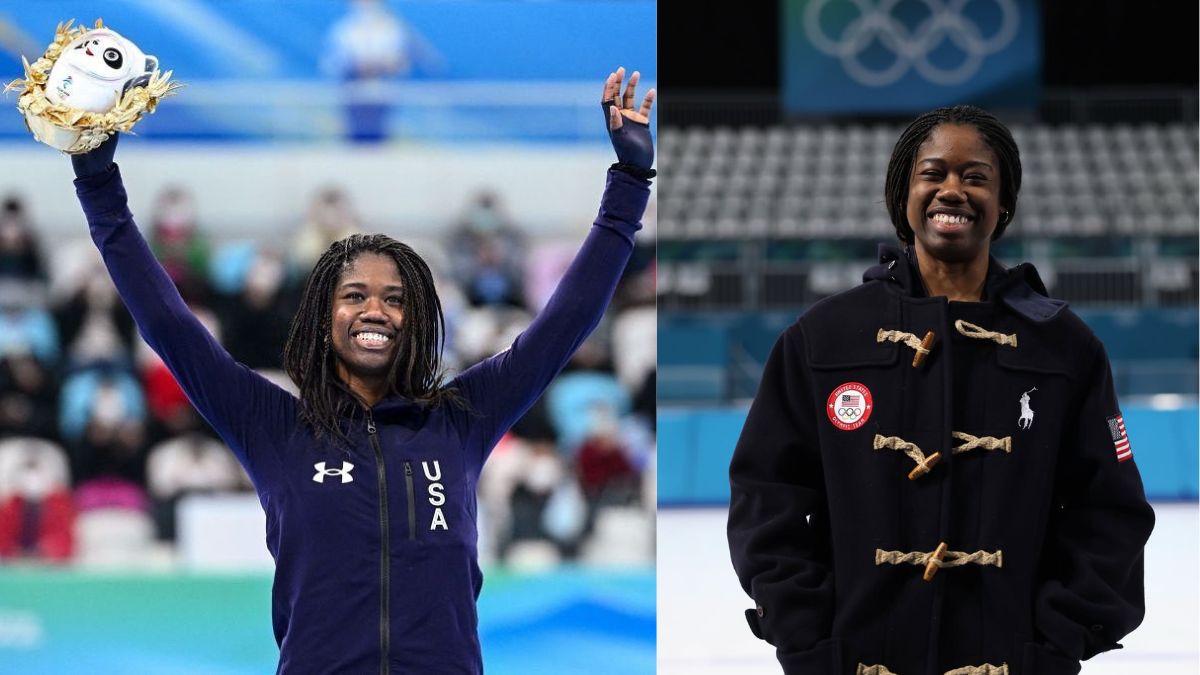
On February 13, 2022, in Beijing’s Ice Ribbon venue, Erin Jackson won Olympic gold with a time of 37.04 seconds, defeating Japan’s Miho Takagi by 0.08 seconds. She became the first Black woman to win an individual Winter Olympic gold medal and the first American woman to win the 500-meter since Bonnie Blair in 1994. According to Team USA official records, this victory represented not just personal triumph but a barrier-breaking moment for representation in winter sports.
Personal Life
Erin keeps her romantic life private. Public records don’t confirm a husband or long-term partner, though she’s mentioned in interviews that she prefers focusing on her career during peak competitive years.
She lives in Utah with her father Tracy, who provides daily support and companionship. Her brother Corey Farmer works in the roofing industry in Florida with his wife, and Erin maintains close ties with her large extended family—both parents came from big families, giving her numerous aunts, uncles, and cousins.
In her free time, she watches TV, travels, and bowls. She describes herself as someone who can “fall asleep anywhere, anytime”—a useful skill for athletes who travel constantly. She has over 113,000 Instagram followers under the handle @speedyj, where she shares training updates and occasional personal moments.
Net Worth
Estimates of Erin’s net worth vary widely and lack reliable confirmation. Olympic medals provide small cash bonuses—$37,500 for gold—but her income comes primarily from USA Speedskating stipends, World Cup prize money, and sponsorships. Her net worth is likely in the several hundred thousand dollar range, modest compared to mainstream professional athletes.
Why Her Story Matters
Erin Jackson’s journey from a chance pharmacy conversation to Olympic gold demonstrates how opportunity, talent, and family support combine to create excellence. Her mother’s curiosity about a skating program, her parents’ commitment to education funding, her father’s willingness to move states to support her training—these decisions shaped an Olympic champion.
Her rapid transition from inline skating to Olympic gold in four years challenges assumptions about how long elite performance takes to develop. Her willingness to compete in multiple sports—inline skating, roller derby, long-track speedskating—shows that athletic versatility builds unique strengths.
Most importantly, as the first Black woman to win individual Winter Olympic gold, she’s opened doors and changed what’s possible for young athletes who don’t see people who look like them in winter sports. She didn’t set out to break barriers—she just wanted to skate fast. But her success created new possibilities for the next generation.
Read Also: Who Is Darwin Blanch? Early Life, Tennis Journey and Background
About The Author