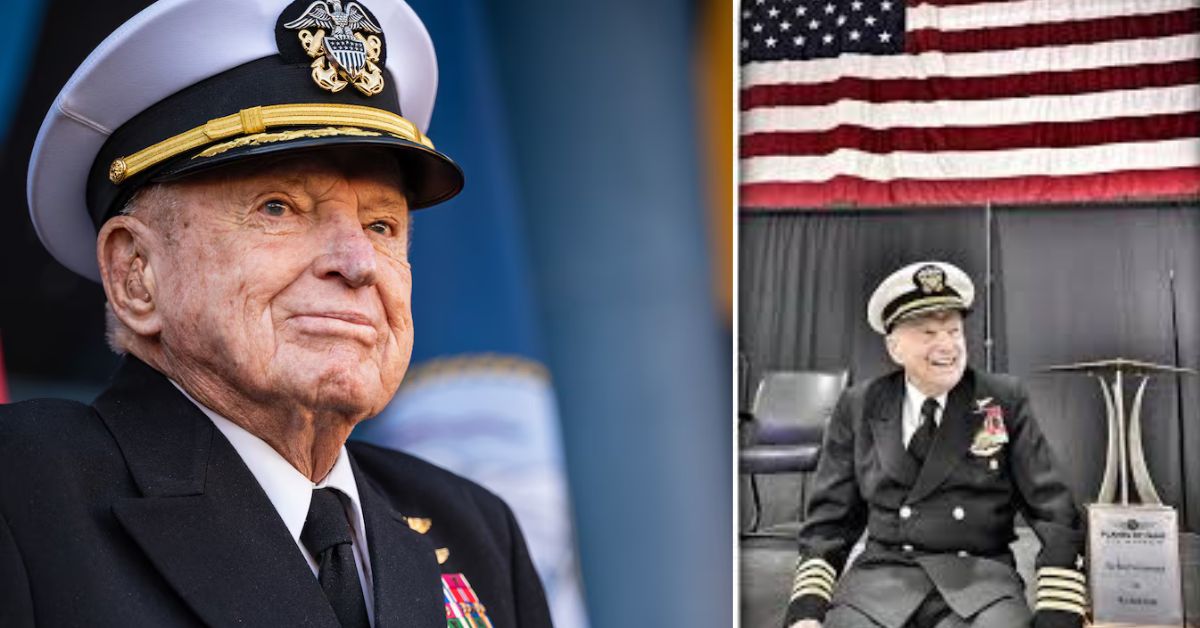
Royce Williams is a 100-year-old retired United States Navy Captain who received the Medal of Honor on February 24, 2026, during President Trump’s State of the Union Address. First Lady Melania Trump presented him with America’s highest military decoration for his heroic actions 73 years earlier.
On November 18, 1952, he fought alone against seven Soviet MiG-15 fighter jets in what military experts call one of the greatest feats in aviation history. The 35-minute dogfight remains the longest aerial engagement by a single pilot in U.S. Navy history.
He shot down four of the seven Soviet aircraft while his own plane suffered 263 bullet holes. The mission remained classified for over 60 years, and he kept silent about it even to his own wife until the government declassified the records.
His story represents courage, duty, and sacrifice during the Cold War. He is now considered a legend among naval aviators and military historians who study aerial combat.
Early Life in South Dakota
Elmer Royce Williams was born on April 4, 1925, in Wilmot, South Dakota. This small town in the northeastern part of the state shaped his character and values during the Great Depression years.
His father was a grocer and a World War I veteran. Growing up in a family that understood military service influenced his decision to join the Navy after Pearl Harbor.
According to an interview with South Dakota Public Broadcasting, he grew up in an environment where everyone was friendly and looked after one another. Kids learned to swim, shoot, and played cowboys and Indians games around town.
He and his brother both wanted to become pilots from a young age. This dream would eventually take both of them into military aviation, though Royce’s path would prove extraordinary.
The open spaces of South Dakota and the close-knit community taught him self-reliance and responsibility. These qualities would serve him well during the most dangerous moments of his military career.
Joining the Navy and Becoming a Pilot
Royce Williams enlisted in the United States Navy in 1941, shortly after the attack on Pearl Harbor. Like many young Americans, he felt compelled to serve his country during World War II.
His flight training was initially deferred while he attended college in Minnesota. The Navy wanted educated officers, so he completed his college education before beginning pilot training.
He finally qualified as a naval aviator at Pensacola, Florida in August 1945, just as World War II was ending. While he missed combat during that war, his training prepared him for what would come during the Korean conflict.
He originally trained to fly propeller-driven aircraft like the Vought F4U Corsair. However, he transferred to jet training because he wanted to fly the newest technology available to naval aviators.
He was assigned to VF-781, known as “the Pacemakers,” which flew the Grumman F9F-5 Panther. This jet would save his life during the famous dogfight seven years later.
Read Also: John Barron Biography: Journalism Career, Wife, Parents, Education & Height
The Historic November 18, 1952 Dogfight
On November 18, 1952, Lieutenant Williams was assigned to Combat Air Patrol duty aboard the USS Oriskany, operating off the North Korean coast. The task force was near the Soviet border, creating heightened tension.
He and three other pilots launched during a blizzard. Radar detected seven Soviet MiG-15 fighters approaching from Vladivostok.
Two of the American planes were ordered back to the carrier, leaving just Williams and his wingman. When the MiGs attacked, Williams hit one immediately. His wingman chased the damaged MiG, leaving Williams alone against six remaining Soviet fighters.
The Soviet MiG-15 was faster and more maneuverable than his F9F Panther. However, Williams had better gunsight systems and superior training. For the next 35 minutes, he fought for his life.
He flew tight turns, firing brief bursts at Soviet planes as they came into his sights. He fired all 760 of his 20mm rounds, shooting down four MiGs total. Two others were damaged and likely crashed later.
One Soviet aircraft hit his Panther with a 37mm cannon round that tore into his wing. His plane suffered 263 bullet holes from cannon fire and shrapnel. He lost hydraulics and nearly lost control.
According to reporting from Task & Purpose, he managed to fly the damaged aircraft back to the carrier. American destroyers accidentally fired on him, mistaking him for enemy aircraft, but missed.
He landed the crippled Panther on the carrier deck at high speed in rough seas. The landing was dangerous because he couldn’t slow down normally without losing control. He survived uninjured, though his plane was barely flyable.
The Decades of Secrecy
After the mission, military commanders immediately debriefed Williams. Admirals, the Secretary of Defense, and President-elect Dwight Eisenhower wanted to know what happened.
The Soviet Union was not officially involved in the Korean War. American signal intelligence had intercepted Soviet communications directing the attack, but revealing this information could have escalated tensions into World War III.
Williams was ordered to keep silent about the true nature of the engagement. He was told never to discuss that he had fought Soviet pilots. For over 60 years, he obeyed that order.
He initially received the Silver Star in 1953, but his official record stated he shot down one enemy aircraft and damaged another. The true number remained classified.
He never told anyone, including his wife, about the real details of the mission. He kept this enormous secret throughout his entire Navy career and into retirement.
Only after the U.S. government contacted him years later to inform him the mission had been declassified did he finally tell his wife. By then, Soviet records released after the Cold War ended had confirmed his account.
Vietnam Service and Naval Career
Williams’ military career extended far beyond the Korean War. Between 1965 and 1967, he flew 110 combat missions during the Vietnam War.
He piloted A-4 Skyhawks and F-4 Phantoms from the aircraft carrier USS Kitty Hawk. This demonstrated his ability to adapt to new aircraft and continue performing at high levels even in his forties.
He eventually commanded a ship and held various leadership positions throughout his 37-year Navy career. He served with distinction in multiple roles beyond flying combat missions.
He retired as a Captain after decades of service. Throughout all those years, he never discussed his most famous accomplishment because it remained classified.
His military decorations include the Navy Cross (upgraded from Silver Star in 2023), two Distinguished Flying Crosses, and the Legion of Merit with Combat “V.” These awards reflect a career of consistent excellence and bravery.
Recognition After Decades
In 2014, a Russian book titled “Red Devils over the Yalu: A Chronicle of Soviet Aerial Operations in the Korean War 1950–53” confirmed Williams’ account. The book named him and described the four Soviet pilots he shot down.
Soviet records showed that of the seven MiGs in the fight, only one returned to base. Captains Belyakov and Vandalov, and Lieutenants Pakhomkin and Tarshinov were the pilots killed in action.
Military advocates began pushing for proper recognition of Williams’ actions. Retired Rear Admiral Doniphan Shelton and Congressman Darrell Issa led efforts to upgrade his awards.
In December 2022, Secretary of the Navy Carlos Del Toro approved upgrading his Silver Star to the Navy Cross. He received this award in January 2023 at age 97.
Congress passed the “Valor Has No Expiration Act” in 2025, eliminating the five-year statute of limitations for Medal of Honor awards. This cleared the way for Williams to receive the nation’s highest honor.
President Trump called Williams personally in early February 2026 to inform him he would receive the Medal of Honor. On February 24, 2026, he received it during the State of the Union Address at age 100.
Personal Life
Royce Williams has lived in the San Diego area for many years, specifically in Congressman Darrell Issa’s district in California. He raised his family there after his military retirement.
He was married, though his wife’s name and personal family details remain private. The most public fact about his marriage is that he kept his greatest military achievement secret from her for over 50 years because of his oath.
When declassification finally allowed him to tell her, it was the first time she learned that her husband was one of the greatest fighter pilots in American history. This sacrifice demonstrates his commitment to duty above personal recognition.
He turned 100 years old on April 4, 2025. At his centennial birthday, he was still waiting for final confirmation of the Medal of Honor, which came ten months later.
His humble nature stands out to everyone who meets him. Despite his extraordinary accomplishments, he describes himself simply as “a fighter pilot doing my job.”
He maintains connection with the South Dakota community where he grew up. Local news outlets have followed his story with pride, celebrating their hometown hero.
Physical Condition at 100
At 100 years old, Royce Williams remains mentally sharp and physically capable of traveling to Washington D.C. for the Medal of Honor ceremony. The White House flew him and his family to the capital on a private jet.
He sat beside First Lady Melania Trump during the State of the Union Address and stood to receive his medal in front of Congress and the nation. His ability to participate fully in the ceremony impressed everyone present.
His longevity and health allow him to finally receive recognition that was denied for so many decades. Many Medal of Honor recipients never live to see their awards, making his story even more remarkable.
Read Also: Aileen Cannon Biography: Federal Judge, Career and Personal Life
About The Author