
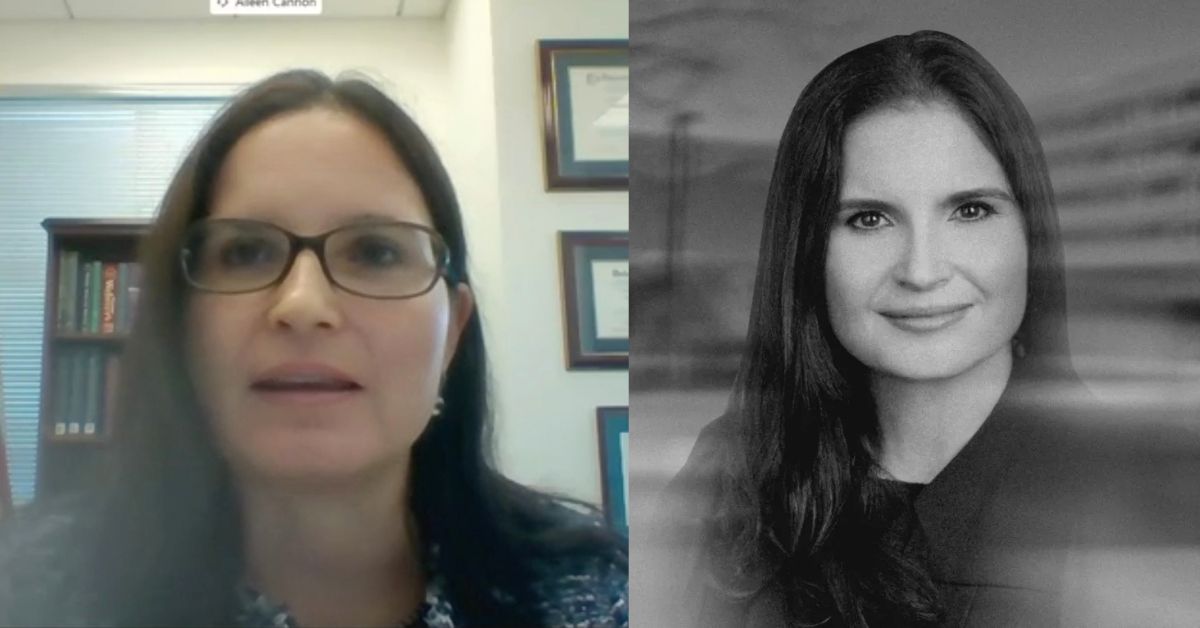
Aileen Mercedes Cannon is a United States District Judge for the Southern District of Florida. She was born in 1981 in Cali, Colombia, and became a federal judge in November 2020 at the age of 39.
She is one of the youngest federal judges currently serving in the United States. President Donald Trump nominated her in May 2020, and the Senate confirmed her in November 2020 by a vote of 56-21.
She became widely known to the public through her involvement in high-profile legal cases, particularly those involving former President Trump. Her judicial decisions have attracted significant attention from both legal experts and the general public.
Early Life and Family Background
Aileen Mercedes Cannon was born on November 17, 1981, in Cali, Colombia. Her mother fled Cuba during the Cuban Revolution in the 1950s and eventually settled in Colombia, where Aileen was born.
Her father is from Indiana. This gives Aileen a unique multicultural heritage that includes Colombian, Cuban, and American roots. She has mentioned that this background influenced her perspective throughout her life.
When she was young, her family moved to the United States. She grew up in Miami, Florida, with her older sister. Miami’s large Cuban-American community meant she was surrounded by people who shared similar immigrant experiences.
Details about her parents remain largely private. She has not publicly shared their names or specific information about their careers. She keeps most family matters out of the public eye.
Growing up in Miami gave her exposure to both American culture and Latin American traditions. She became fluent in both English and Spanish, which later helped her career in South Florida.
Education
Aileen Cannon attended Duke University in Durham, North Carolina, where she earned her Bachelor of Arts degree in 2003. Duke is one of the most prestigious universities in the United States.
After completing her undergraduate education, she attended the University of Michigan Law School in Ann Arbor. She graduated with her Juris Doctor degree in 2007.
During law school, she was recognized for her academic achievements. She became a member of the Order of the Coif, which is an honor society for law students who graduate in the top 10 percent of their class.
According to the Federal Judicial Center, her legal education provided the foundation for her career in both private practice and government service.
Early Legal Career
After graduating from law school in 2007, Cannon began working as a law clerk. From 2008 to 2009, she served as a law clerk for Judge Steven Colloton of the United States Court of Appeals for the Eighth Circuit in Iowa.
Judge Colloton is known as a conservative jurist, and working for him gave her experience in appellate law and judicial procedures. Clerkships with federal appellate judges are highly competitive positions that help young lawyers develop their skills.
Following her clerkship, she joined the corporate law firm Gibson Dunn & Crutcher. From 2009 to 2012, she worked as an associate in their Washington, D.C. office.
During her time at Gibson Dunn, she worked on various corporate legal matters. In one notable case in 2011, she defended a former financial executive before the Financial Industry Regulatory Authority. Her client was cleared of fraud charges.
Working at a major law firm gave her experience in complex litigation and corporate law. However, after three years in private practice, she decided to move into public service.
Career as Federal Prosecutor
In 2013, Cannon left private practice to become an Assistant United States Attorney for the Southern District of Florida. She served in this role for seven years, until 2020.
As a federal prosecutor, she worked in the appellate section’s criminal division. This meant she handled appeals of criminal cases rather than conducting trials. She represented the government in appellate courts.
During her time as a prosecutor, she earned several recognitions for her work. In 2017, she won the Timothy Evans Award. In 2019, she received a Certificate of Achievement for her work on United States v. Gibbs.
Federal prosecutors typically earn modest salaries compared to private practice. At that time, assistant U.S. attorneys in Florida earned approximately $67,000 per year. This showed her commitment to public service over financial gain.
Her seven years as a prosecutor gave her extensive experience in federal criminal law and courtroom procedures. This experience would later be important when she became a judge.
Nomination and Confirmation as Federal Judge
In June 2019, Senator Marco Rubio’s office indicated they were considering Cannon for a federal judge position. She expressed interest and was interviewed by representatives for both Senator Rubio and Senator Rick Scott.
She also met with White House and Justice Department officials as part of the vetting process. On May 21, 2020, President Donald Trump officially nominated her to become a United States District Judge.
She was nominated to fill the seat left vacant by Judge Kenneth Marra, who had taken senior status in August 2017. The seat had been open for nearly three years.
The American Bar Association rated her as “Qualified” for the position. The ABA requires at least 12 years of law practice for judicial nominees, and Cannon barely met this standard with exactly 12 years of experience.
During her Senate Judiciary Committee hearing in July 2020, she described her judicial philosophy as originalist and textualist. This means she believes in interpreting the Constitution based on its original meaning and laws based on their text.
The Senate confirmed her on November 12, 2020, by a vote of 56-21. She received her commission the next day, on November 13, 2020. At age 39, she was one of the youngest federal judges in the country.
Read Also: Samuel Alito Biography: Early Life, Family, Career and Journey to the Supreme Court
Judicial Philosophy and Federalist Society Membership
Cannon has been a member of the Federalist Society since 2005, when she was still a law student. The Federalist Society is a conservative and libertarian organization focused on constitutional law.
During her confirmation process, she explained that she joined the organization because of its “diversity of viewpoints.” She said she found interesting the Society’s discussions about constitutional separation of powers, the rule of law, and the limited role of the judiciary.
She believes judges should “say what the law is—not to make the law.” This judicial philosophy emphasizes that judges should interpret existing laws rather than create new policies from the bench.
Her membership in the Federalist Society is not unusual. Many conservative judges and lawyers belong to this organization. However, it does indicate her general legal philosophy and approach to judging.
Early Cases as a Federal Judge
After becoming a judge in late 2020, Cannon presided over various cases in her first two years. Some of these cases showed her approach to sentencing and legal interpretation.
In June 2021, she ordered Swiss cement company LafargeHolcim to compensate an American family under the Helms-Burton Act. The family’s property in Cuba had been seized by the Cuban government in 1960. Before her order, no one had secured compensation under this Act for business property taken in Cuba.
In April 2022, she sentenced Christopher Wilkins, a man who threw a chair at a federal prosecutor, to an additional six and a half years in prison on top of his existing 17.5-year sentence for gun charges.
In July 2022, she sentenced Juan Antonio Garcia, a former police officer, to 25 years in federal prison for soliciting sex from a teenage boy. Sentencing guidelines suggested 15 years to life, and prosecutors requested over 30 years. Her sentence fell in the middle of this range.
She also presided over complex multi-defendant cases, including United States v. Carver, an 18-month health care fraud case. In that case, she generally ruled in favor of the prosecution on issues of attorney-client privilege and evidence suppression.
High-Profile Trump Cases
Cannon became nationally known through her handling of cases involving former President Donald Trump. In August 2022, Trump filed a lawsuit after the FBI searched his Mar-a-Lago residence and seized documents.
On September 5, 2022, she granted Trump’s request to appoint a special master to review the seized materials for attorney-client privilege and executive privilege. She also ordered the Justice Department to stop using the materials in their investigation.
Many legal experts criticized this decision as unusual and legally questionable. The Eleventh Circuit Court of Appeals later reversed her ruling, stating she “improperly exercised equitable jurisdiction” over the case.
In 2023, she was assigned to preside over the federal criminal case against Trump regarding classified documents found at Mar-a-Lago. This became one of the most high-profile cases in American legal history.
In July 2024, she dismissed the classified documents case entirely. She ruled that Special Counsel Jack Smith’s appointment was unconstitutional. This decision was highly controversial and has been appealed.
Most recently, on February 23, 2026, she ruled against releasing Special Counsel Jack Smith’s final report on the Trump classified documents case. She cited concerns about protected discovery material and grand jury information.
Personal Life and Marriage
Aileen Cannon married Josh Lorence in 2008. Josh works as a restaurant executive and has served as Chief Operating Officer for Bobby’s Burgers since 2015. The company is based in Charlotte, North Carolina.
When they married, Josh was 27 years old and working as a restaurant manager in Miami. Aileen was 28 years old. According to sources, they dated for about five years before getting married.
The couple has two children, though they have not shared their names or ages publicly. They value privacy and keep their family life out of the media spotlight.
According to property records reported by CounterPunch, Josh Lorence purchased their home in Vero Beach, Florida, on August 24, 2020, for $750,000. This was three months after Trump nominated Aileen and one month after her confirmation hearing, but three months before she was actually confirmed.
As of 2022, the family lives in Vero Beach, Florida. This is located in Indian River County, about 120 miles north of Miami. The area is known for its beaches and relatively quiet lifestyle.
Cannon is registered as a Republican. She maintains a private personal life and does not have public social media accounts. This privacy allows her to separate her personal life from her public role as a judge.
Net Worth and Financial Information
Aileen Cannon’s net worth is estimated to be between $1.5 million and $8.5 million, depending on the source. These figures are estimates only and should not be considered exact.
As a federal district judge, her annual salary is set by Congress. As of 2024, federal district judges earn approximately $223,400 per year. This is a public salary paid by taxpayer funds.
Before becoming a judge, she earned significantly more in private practice at Gibson Dunn, where associates at major law firms can earn over $150,000 per year. However, she earned much less as an Assistant U.S. Attorney, approximately $67,000 annually.
Her husband Josh’s salary as Chief Operating Officer for Bobby’s Burgers is estimated at around $73,000 to $92,000 per year based on industry standards for restaurant executives.
The couple’s home in Vero Beach was purchased for $750,000 in 2020. Property values in that area have likely increased since then, adding to their net worth.
It is important to note that federal judges must file annual financial disclosure forms. These forms show income, assets, and potential conflicts of interest. However, specific details from these forms are not always made public.
Net worth estimates for judges include their home value, savings, investments, and any other assets. The actual figure could be higher or lower depending on debts, investments, and expenses that are not publicly known.
Controversies and Criticism
Cannon’s judicial decisions, particularly in cases involving Trump, have generated significant controversy. Legal experts across the political spectrum have criticized some of her rulings.
In the Mar-a-Lago documents case, her decision to appoint a special master was overturned by the Eleventh Circuit. The appeals court stated she had overstepped her jurisdiction and created special protections for Trump that don’t exist in law.
Law professors from Duke University and New York University publicly commented that the appeals court’s rebuke was unusually strong. They noted it would likely affect her judicial legacy.
Her decision to dismiss the classified documents case in July 2024 drew even more criticism. Many legal scholars argued that the reasoning was legally weak and that Special Counsel appointments have been upheld by courts for decades.
Critics have accused her of showing favoritism toward Trump, who nominated her to the bench. Supporters argue she is simply following her judicial philosophy and making decisions based on legal interpretation.
The controversy has raised questions about judicial independence and whether judges appointed by a president should recuse themselves from cases involving that president.
Read Also: John Barron Biography: Journalism Career, Wife, Parents, Education & Height
About The Author