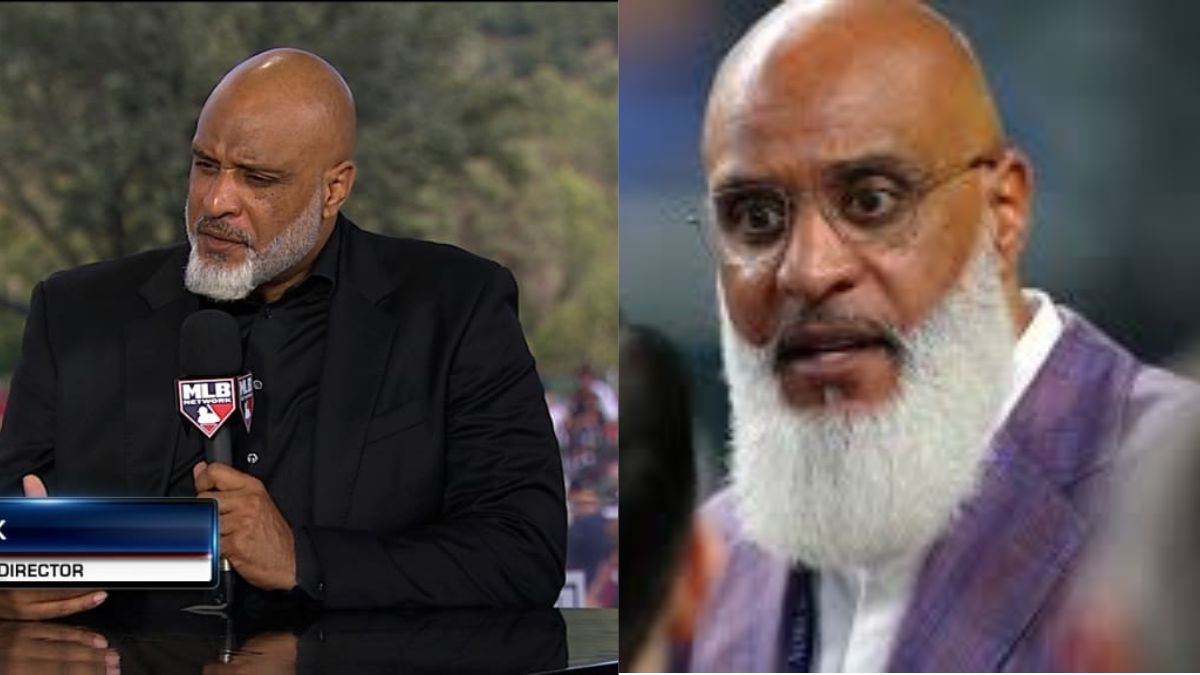
There is a version of Tony Clark’s story that focuses entirely on the numbers. Two hundred and fifty-one home runs. Eight hundred and twenty-four RBIs. A .262 batting average across fifteen seasons with six different teams. A second overall pick in the 1990 MLB Draft. An All-Star in 2001.
Those numbers are real, and they matter. But they don’t explain the full picture of who Tony Clark is — a kid born in Newton, Kansas, to a Navy father and an accountant mother, who grew up in San Diego without a single professional athlete in his family tree, and somehow became one of the most recognizable first basemen of his generation before reinventing himself entirely as the most powerful labor executive in baseball.
His story is two careers, one family, and a lot of basketball in between.
Where He Came From
Anthony Christopher Clark was born on June 15, 1972, in Newton, Kansas. He was raised in San Diego, California. The family’s move from the Kansas heartland to the California coast traced his father’s military service — his father served in the Navy in the 1970s for 21 years, reflecting a disciplined, service-oriented family rather than one tied to organized sports or unions. His mother, Patty, worked as a city accountant, providing financial stability through public sector employment.
Neither parent was a professional athlete. There were no MLB connections, no youth travel teams funded by sponsorship money, no elite coaching from early childhood. Clark’s foundational interest in baseball and basketball stemmed from accessible, grassroots opportunities in San Diego’s community settings, including the Encanto Branch of the Boys & Girls Clubs, where he honed his skills alongside his brothers.
That background matters. A lot of first and second overall picks grow up inside well-resourced systems. Clark grew up in a Boys & Girls Club.
High School Basketball Career
Clark initially attended Valhalla High School in El Cajon, California, before transferring to nearby Christian High School after going out to dinner with principal Ed Giles and others. The change of schools didn’t slow him down — it accelerated everything.
What he did on a basketball court at Christian High School was genuinely extraordinary. He amassed a then-San Diego-area high school basketball record with 2,549 career points while averaging 43.7 points per game his senior year en route to a state scoring title. He also broke Bill Walton’s San Diego high school single-season scoring record with 1,337 points as a senior.
Let that number sit for a moment. Forty-three points per game. In high school. From a kid who grew up playing pickup basketball at the Boys & Girls Club.
He earned All-American and Academic All-American honors in both baseball and basketball — a combination that told any scout paying attention they were looking at something unusual. The Detroit Tigers were paying attention.
MLB Draft and Two-Sport College Years
The Detroit Tigers selected Clark with the second overall pick in the 1990 MLB Draft out of Christian High School in El Cajon, California, and gave him a $500,000 signing bonus.
Most players drafted that high go straight into professional baseball. Clark did something different. He went to college — to play basketball. He played college basketball at the University of Arizona and San Diego State University, where he was the San Diego State Aztecs’ top scorer with 11.5 points per game in 1991-92. He also played in the minor leagues during this period, developing both simultaneously.
That two-sport college phase was unusual then and would be almost impossible now. He was developing as a professional baseball player in the summers while averaging double figures for a Division I basketball program in the winters. Eventually, he chose baseball permanently. He left college without finishing his business administration degree in order to focus on baseball. The degree would wait. The major leagues would not.
Major League Baseball Career (1995–2009)
Clark made his Major League debut on September 3, 1995, against the Cleveland Indians — five years after being drafted second overall. The wait had been long, but he arrived ready.
His rookie season in 1996 was everything Detroit had hoped for. He finished third in Rookie of the Year voting in 1996, establishing himself as one of the most promising young first basemen in the American League. Detroit’s fans embraced him quickly, and the nickname arrived naturally: “Tony the Tiger” — a nod to the Frosted Flakes mascot and his membership in the Tigers organization.
His seven seasons in Detroit became the foundation of his legacy as a player. He was powerful from both sides of the plate as a switch hitter, capable of driving balls out to any part of the park. At 6 feet 7 inches and 245 pounds, he played primarily first base but also logged time at designated hitter and outfield positions across 1,559 career games.
Read Also: Tobias Myers Biography: Early Life, Baseball Career and Background
Career Highlights and Key Statistics
After Detroit, Clark moved through the league in a way that defined the second half of his playing career. He played for the Boston Red Sox in 2002, the New York Mets in 2003, the New York Yankees in 2004, the Arizona Diamondbacks from 2005 to 2007, the San Diego Padres in 2008, and returned to Arizona until he retired in 2009.
The Yankees stint produced one of his most memorable individual moments. During an August 28 game, Clark hit a career-high three home runs in an 18-6 rout of the Blue Jays in Toronto — including round-trippers from both sides of the plate, the eighth time in his career he had accomplished that feat.
His Arizona seasons showed what he could do in a more limited role. In 2005, in a limited role of 349 at-bats, he hit .307 with 30 home runs and 87 RBIs — numbers that would represent a career year for most players, coming from a man accepting a bench role with dignity and producing beyond expectation.
According to career statistics available baseball-reference.com, his final career line reads .262 batting average, 251 home runs, 824 RBIs, and 1,188 hits across 1,559 games — the product of fifteen seasons spent contributing to six different organizations.
Wife, Family and Home Life
Tony Clark married Frances, and together they have three children: Kiara, born September 20, 1994; Jazzin, born September 15, 1997; and Aeneas, born March 7, 2002.
The family currently resides in Phoenix, Arizona, having previously lived in New York. Clark has maintained a private family life throughout his post-playing career, keeping his children largely out of public visibility. Frances has not been a prominent public figure, and the family’s decision to build a quiet home in the Phoenix area reflects Clark’s broader preference for stability over spotlight.
His three children were born across three different chapters of his playing career — Kiara arriving just before he debuted in the majors, Jazzin during his early Detroit years, and Aeneas while he was navigating the middle portion of his career. The family has stayed together through relocation and professional change, which in baseball — a sport that scatters families across cities — is itself an achievement.
Physical Profile
Clark stands 6 feet 7 inches tall and played at approximately 245 pounds throughout his career. His size was both an advantage and, late in his career, a complication. Large athletes often face more wear on joints and connective tissue, and Clark’s shoulder surgery in 2006 reflected exactly that — a right shoulder injury required significant surgery to repair his labrum, battering his .197 average that year and limiting his effectiveness.
His switch-hitting ability at 6-foot-7 was genuinely rare. Most very tall first basemen develop one dominant batting side. Clark’s natural athletic ability — the same instincts that made him a scoring machine in high school basketball — allowed him to generate real power from both sides across his entire career.
Read Also: Jenna Bandy: Basketball Career, Social Media Rise and Personal Journey
Ethnicity and Background
Tony Clark is African American. He grew up in San Diego, California, the son of a Navy veteran father and a city accountant mother, in a household shaped by discipline, public service, and community values rather than athletic pedigree. His connection to the Boys & Girls Club of San Diego reflects the grassroots environment where his talent was first developed.
In recognition of his success and support for youth development programs, he was inducted into the Boys & Girls Clubs of America Alumni Hall of Fame on May 15, 2017. He has also received the Jackie Robinson Lifetime Achievement Award, a recognition that acknowledges contributions both on and off the field.
He has not publicly discussed religious beliefs in verified media appearances, and that aspect of his personal life remains private.
From Player to Union Leader
While still active as a player, Clark was involved in union work at a level most athletes never approach. He attended his first MLBPA executive board meeting in 1999 and was a team player representative and association representative for several seasons. He was an active participant in the union’s collective bargaining in 2002 and 2006 and in negotiations regarding Major League Baseball’s drug policy.
After retiring in 2009, he didn’t drift toward broadcasting or coaching the way many players do. He went to work. In March 2010, Clark was hired as the MLBPA’s Director of Player Relations. He rose through the staff, served as deputy executive director, and then, following the death of executive director Michael Weiner, Clark was unanimously voted executive director of the Major League Baseball Players Association in December 2013 — becoming the first former major league player to hold the position.
That role has defined his second act more completely than any single moment in his playing career. He led the MLBPA through the contentious 2021-22 MLB lockout, worked to unionize minor league baseball players in 2022, and guided the organization’s affiliation with the AFL-CIO. His contract was extended by five years after the 2022 season.
His tenure has not been without controversy. In March 2024, a faction of MLB players launched an effort that raised questions about union strategy and staff performance, with some players calling for an independent audit of union spending and greater focus on player development pathways. Clark described the campaign as a “secret effort” undermining collective bargaining. These tensions reflect the complex nature of labor leadership rather than personal failure, and he has continued in the role.
Career Earnings and Net Worth
Tony Clark’s playing career salary information, while not fully public across all seasons, reflects the career arc of a top-five pick who became a productive major leaguer across fifteen seasons. His final contract in 2009 was worth $800,000, reflecting his late-career bench role. During his peak years in Detroit and with the Yankees, his salaries would have aligned with starting first baseman market rates of that era, which ranged from several hundred thousand dollars in early arbitration years to multi-million dollar contracts during his prime.
His MLBPA executive director salary is not publicly disclosed in detail, though labor executive positions at his level in professional sports typically command annual compensation in the range of several hundred thousand to over one million dollars annually. His tenure has exceeded a decade in the role.
Various online sources estimate Clark’s net worth at approximately $8 million to $12 million, accounting for career playing earnings, MLBPA executive compensation, and financial management over more than thirty years in professional baseball. These figures are estimates — actual net worth depends on private investment decisions, taxes, and spending patterns that are not publicly available.
His family lives comfortably in the Phoenix area. He has not pursued the high-visibility commercial opportunities — broadcasting contracts, product endorsements — that some former players with his profile might have sought. Following his retirement from playing, he has prioritized a low-profile, family-oriented life centered in the Phoenix area, emphasizing personal stability over high-visibility pursuits.
Career Statistics at a Glance
According to official MLB records, Tony Clark’s complete MLB career statistics break down as follows:
He played in 1,559 games across fifteen seasons from 1995 to 2009. He batted .262 with a .336 on-base percentage and a .489 slugging percentage. He recorded 1,188 hits, including 221 doubles and 251 home runs. He drove in 824 runs and scored 614. As a switch hitter, he threw right-handed and was capable of generating power from both sides of the plate throughout his career. He was named to the American League All-Star team in 2001, finished third in Rookie of the Year voting in 1996, and represented six different franchises across his career.
His 251 home runs place him in the tier of productive, above-average power hitters who shaped their era without dominating it — the kind of player whose value is fully visible only when you watch the teams he anchored rather than compare him to the Hall of Fame names around him.
Read Also: Joey Loperfido: MLB Career, Family Background and Baseball Journey
About The Author