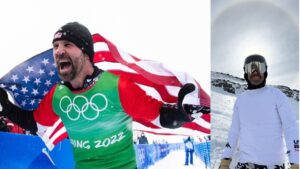
When Nick Baumgartner stepped onto the Olympic podium in Beijing in February 2022, he was 40 years old. Most athletes his age are retired, coaching younger athletes, or watching from living rooms back home. He was competing at his fourth Winter Olympics, doing the thing he had chased for two decades—and finally winning gold.
His story doesn’t fit the typical athlete narrative. There were no wealthy sponsors funding him in his early twenties. No elite training academy. Between competitions, he was back in Iron River, Michigan, pouring concrete. He became known on social media as the #BlueCollarOlympian, and the hashtag wasn’t marketing—it was just the truth.
What makes his career worth examining isn’t just the medal. It’s everything that came before it.
Quick Profile
| Category | Details |
|---|---|
| Full Name | Nick Baumgartner |
| Date of Birth | December 17, 1981 |
| Age | 43 years old (as of 2025) |
| Birthplace | Iron River, Michigan, USA |
| Nationality | American |
| Parents | Robert Baumgartner (father), Mary Baumgartner (mother) |
| Siblings | Three older brothers, one younger sister |
| Education | West Iron County High School; Northern Michigan University |
| Sport | Snowboard Cross (SBX) |
| Height | 6’0″ (1.83 m) |
Growing Up in Iron River
Nick Baumgartner was born on December 17, 1981, in Iron River, Michigan, a small town in the Upper Peninsula with a population of around 3,000 people. His parents are Robert and Mary Baumgartner, and he grew up in a working-class household shaped by the rhythms of small-town Midwest life.
He had three older brothers and a younger sister. In a family of athletes, competition came early and came often. His brothers were standout athletes in everything they tried, and rather than being discouraged by always being the youngest, he used it as fuel. “They set the bar so high that it pushed me to a new level of competition,” he said in an interview. That drive to match—and eventually beat—his siblings became a defining characteristic throughout his life.
The Upper Peninsula isn’t the most glamorous corner of America. Winters are brutal. Temperatures regularly drop below zero. The nearest major city is hours away. But the region shaped him. It taught him to work for things without expecting shortcuts, and to take pride in where he came from even when the rest of the country wasn’t paying attention.
Read Also: Vladyslav Heraskevych Biography: Life, Career, and Ukraine’s First Olympic Skeleton Racer
From the Football Field to the Slopes
Baumgartner was a gifted multi-sport athlete at West Iron County High School. He was a wrestling state champion in 2000, a silver medalist hurdler in the Upper Peninsula track championships, and earned All-State recognition in football. When he graduated—one of just a dozen kids in his class—he went on to play football at Northern Michigan University.
College didn’t go as planned. He showed up, competed hard, but without structure around the rest of his life, things fell apart. The dean eventually sent him a letter making it clear he wasn’t welcome back. He returned to Iron River without a degree and without a clear plan.
Snowboarding had always been part of his winters. Ski Brule, the local hill just ten minutes from his house, had 11 lifts and 17 trails—modest by any serious mountain’s standards, but enough to fall in love with the sport. He rode on weekends and weeknights when the resort stayed open after dark. When he saw other snowboarders competing on television and thought he might be able to beat them, he got curious enough to find out.
“The next best thing was to be a professional snowboarder,” he said later. “I’ve always been about living with as little regret as possible, so why not give it a try?”
The gap between Iron River and the professional snowboard circuit was enormous. He had no resources, no mentors, and no obvious pathway. So he got creative, competed in regional events through the USASA circuit, and worked construction jobs to pay his bills while training whenever he could.
Building a Career the Hard Way
His early competitive results were promising enough to keep going. In 2004, he placed first at multiple USASA events. In 2008, he earned his first World Cup victory in Lake Placid, New York. In 2009, he took bronze at the FIS Snowboarding World Championships in Gangwon, South Korea.
These results were built on mornings of hard physical work followed by evenings on the mountain. Pouring concrete wasn’t a romantic side detail—it was how he funded his athletic career when sponsorships weren’t covering everything. The work ethic wasn’t something he developed as an athlete. It was something he brought to snowboarding from how he’d been raised.
In January 2010, he was named to the U.S. team for the Vancouver Winter Olympics. He finished 20th, which wasn’t the result he wanted, but getting there mattered.
What followed that Olympics showed his character. In January 2011, after being passed over for a World Championships spot, he went to train at Copper Mountain and broke his collarbone in an accident. He needed surgery the next day. Most athletes would have taken weeks to recover quietly. Baumgartner came back, competed at the X Games in Aspen, and won gold—with fifteen screws and a plate in his neck.
After winning, he grabbed his son Landon and said: “To see the look on his face, to have your boy proud of you, there’s nothing better.”
He followed that with a silver medal at the 2012 X Games and multiple World Cup podiums over the following years. He qualified for the Sochi 2014 Olympics, the Pyeongchang 2018 Olympics, and heading into Beijing 2022, he had competed at three straight Winter Games without winning an Olympic medal.
The Beijing Moment
The 2022 Beijing Olympics began with disappointment. Baumgartner was eliminated in the quarterfinals of the individual snowboard cross event. Standing at the bottom of the mountain, he told NBC: “I’m 40 years old. I’m running out of chances. I have so much support back home, and I feel like I let them down. This one stings. This one hurts.”
Then came news he hadn’t expected. The 2022 Games would feature the inaugural mixed team snowboard cross event, and Baumgartner would compete alongside Lindsey Jacobellis. He’d never won an Olympic medal. She was the defending champion. Together, they had a chance.
According to his official U.S. Ski and Snowboard profile, in the final, Baumgartner took the first leg of the race and delivered a slim lead to Jacobellis, who navigated the rest of the course to bring home the gold. The partnership worked exactly as it needed to.
At 40, he became the oldest American snowboarder to win an Olympic medal in history.
Family Life and Personal Details
Baumgartner has a son named Landon Baumgartner, who was around 17 years old when his father won gold in Beijing. The relationship between father and son has been a consistent thread through his public career—he’s mentioned Landon in interviews and after major victories.
View this post on Instagram
Details about his wife or partner are not publicly available, as he has kept that part of his personal life private. He has chosen to keep family matters out of the spotlight beyond what directly connects to his athletic journey. That boundary is worth respecting.
He has spoken about the challenge of balancing training demands with being present for Landon, particularly during the years when competitions required extended travel. Being a father gave him perspective that pure competition couldn’t provide—a reason to keep going that went beyond personal achievement.
Net Worth and Earnings
Baumgartner’s estimated net worth falls somewhere between $1.5 million and $3 million, based on figures reported by various sports publications. These are estimates rather than verified disclosures, and the actual number depends on factors that remain private.
His income came from multiple sources over his career: World Cup prize money, X Games appearance fees and medals, Olympic athlete stipends through the U.S. Olympic and Paralympic Committee, and sponsorships. His sponsors have included brands aligned with his blue-collar identity, though specific endorsement values aren’t publicly documented.
Concrete work provided supplemental income during the years when athletic earnings didn’t cover everything. That combination—professional athlete and construction worker—is unusual at his level of competition but reflects the financial reality many Olympic athletes face outside the high-profile sports like basketball, tennis, or track.
Since his 2022 gold medal, his profile has increased significantly. He published a memoir called Gold From Iron, which chronicles his path from Iron River to the Olympic podium. Public speaking engagements, including events with companies like Cloverland Electric Cooperative and visits to over 50 schools across the Upper Peninsula, have expanded his post-medal career.
Life Beyond Competition
After Beijing, Baumgartner expressed interest in competing at the 2026 Milan-Cortina Winter Olympics, which would make him 44 years old at the time of the Games. Whether that happens remains to be seen, but the ambition alone says something about how he approaches his career.
His work visiting schools across Michigan’s Upper Peninsula after winning gold demonstrated that the community connection was genuine, not a publicity exercise. He spoke with students about perseverance, accountability, and goal-setting—the same values that carried him from a small hill in Iron River to an Olympic podium.
He remains closely connected to Iron River itself, a town he’s never distanced himself from despite the opportunities fame brings to relocate. That loyalty reflects something consistent in his character: a comfort with who he is and where he came from that doesn’t require validation from anywhere else.
Read Also: Federica Brignone Biography: Career, Family and Journey in Alpine Skiing
About The Author