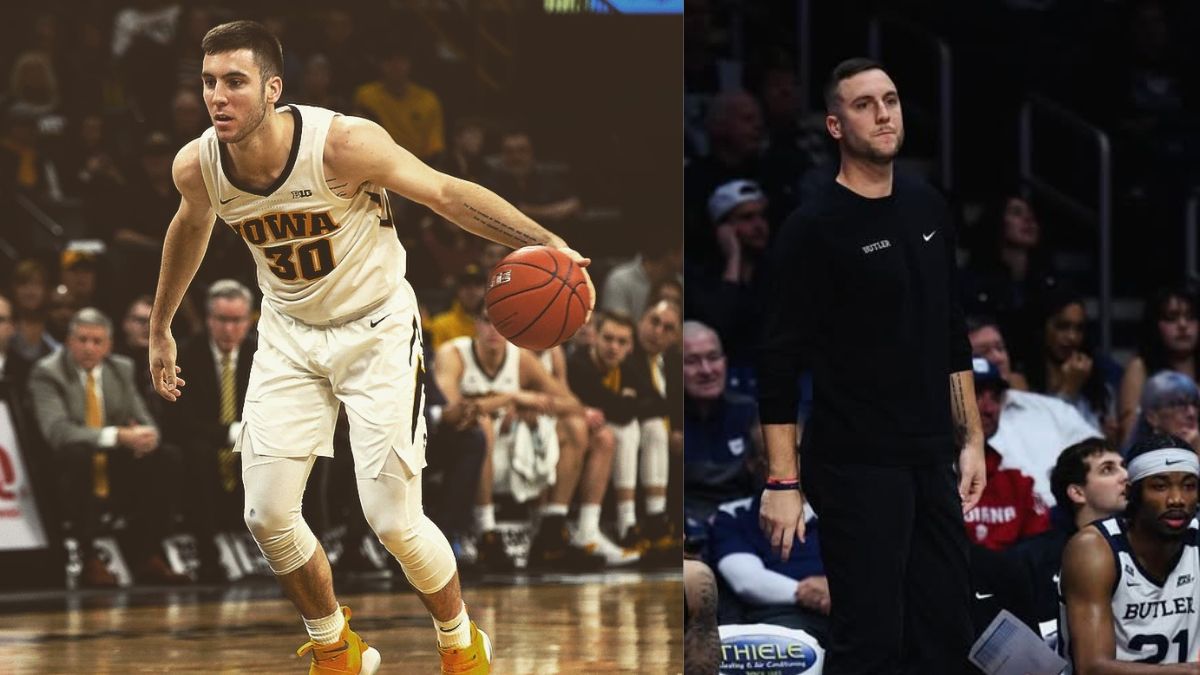
Connor McCaffery built his college athletics career in a unique position—playing basketball and baseball at the University of Iowa while being the son of the school’s head basketball coach. His journey through Iowa athletics represents both opportunity and pressure that few student-athletes experience.
He played multiple sports at the Division I level, demonstrating versatility and athletic ability across different disciplines. His time as a Hawkeye was defined not just by his performance but by the unusual dynamics of playing for his father.
Now transitioning into coaching, his story offers insights into athletic legacy, family dynamics in sports, and the challenges of forging an individual identity within a famous family name.
Quick Profile
| Detail | Information |
|---|---|
| Full Name | Connor McCaffery |
| Date of Birth | July 13, 1998 |
| Age | 27 years old (as of 2026) |
| Birthplace | Iowa City, Iowa |
| Height | 6 feet 5 inches (196 cm) |
| College | University of Iowa |
| Sports Played | Basketball, Baseball |
| Current Role | Basketball Coach/Graduate Assistant |
| Parents | Fran McCaffery (father), Margaret McCaffery (mother) |
| Siblings | Patrick, Jack, Jonathan McCaffery |
Early Life and Growing Up in a Basketball Family
Connor McCaffery was born on July 13, 1998, in Iowa City, Iowa, into a family deeply embedded in basketball culture. His father, Fran McCaffery, has been a college basketball coach for decades, shaping Connor’s upbringing around the sport.
Growing up as a coach’s son meant basketball was more than just a game—it was family life. Connor spent childhood years in gyms, watching practices, attending games, and absorbing basketball knowledge from an early age.
The McCaffery household revolved around sports schedules, recruiting cycles, and the pressures that come with high-level college coaching. This environment provided unique advantages but also created expectations that Connor would eventually face publicly.
His childhood included moves based on his father’s coaching career. Before settling at Iowa, the family lived in different locations as Fran built his coaching resume at various programs.
These experiences gave Connor perspective on the sacrifices coaching families make. The irregular schedules, public scrutiny, and constant evaluation that come with college athletics were familiar long before he became a player himself.
Parents: Fran and Margaret McCaffery
Connor’s father, Fran McCaffery, is one of college basketball’s most recognized coaches. He has been the head coach at the University of Iowa since 2010, building the program into a consistent Big Ten competitor.
Fran’s coaching career includes stops at Lehigh, UNC Greensboro, and Siena before arriving at Iowa. His intense sideline demeanor and passionate coaching style have made him a well-known figure in college basketball.
Fran has led Iowa to multiple NCAA tournament appearances and developed numerous players for professional basketball careers.
Connor’s mother, Margaret McCaffery, has been a stabilizing presence for the family throughout Fran’s coaching career. She has managed the challenges of raising four boys while supporting her husband’s demanding profession.
Margaret’s role, while less public, has been crucial to the family’s success. Coaching families require strong support systems to handle the unique pressures of public life and irregular schedules.
The McCaffery parents have been open about their Catholic faith and how it guides their family values. They have emphasized education, character development, and resilience to their children alongside athletic achievement.
Read Also: Luke Kennard Biography: NBA Journey, Family, Wife, Personal Life & Net Worth
Siblings and Family Dynamics
Connor is the oldest of four McCaffery brothers, all of whom have been involved in Iowa athletics at various levels. This creates a unique family dynamic where multiple generations and siblings share the same program.
His brother Patrick McCaffery also played basketball for Iowa, creating the unusual situation of brothers playing for their father. Patrick has dealt with health challenges, including thyroid cancer, demonstrating the family’s resilience through adversity.
Jack McCaffery, another brother, has also been involved with Iowa basketball. The presence of multiple McCaffery sons on the team created both special family moments and additional scrutiny about nepotism and favoritism.
Jonathan, the youngest McCaffery brother, rounds out the family. Growing up watching older brothers play college athletics while their father coaches provides unique perspective on sports and family.
The brothers share close bonds strengthened by their shared experiences in Iowa athletics. They understand the unique pressures each faces in ways that few others can relate to.
Ethnicity and Cultural Background
Connor McCaffery is of Irish-American descent, as indicated by his surname and family heritage. The McCaffery name has strong Irish roots, common among Irish-American families in the Midwest.
His ethnic background is predominantly European-American, typical of many families in Iowa and the surrounding region. The state has significant populations of Irish, German, and Scandinavian heritage.
While ethnicity has not been a major focus of his public profile, his Irish heritage connects him to the broader Irish-American community that has significantly influenced American sports culture, particularly in basketball and baseball.
Cultural identity for Connor appears centered more on his identity as an Iowans and his family’s basketball legacy rather than specific ethnic traditions or practices.
The diversity of his college athletics experience exposed him to teammates from various backgrounds, broadening his cultural perspectives beyond his own heritage.
Religion and Faith
The McCaffery family is Catholic, and faith plays an important role in their lives. They have spoken publicly about how their religious beliefs provide foundation and perspective through challenges.
Growing up in a Catholic household in the Midwest, Connor was likely raised with traditional Catholic values emphasizing family, service, and moral character. These values appear reflected in how the family handles both success and adversity.
When brother Patrick faced cancer, the family discussed openly how their faith helped them navigate the frightening diagnosis and treatment. This public witness demonstrated how their beliefs provide strength during difficult times.
Connor has not been extensively vocal about his personal religious practices in media coverage, maintaining some privacy about his spiritual life while acknowledging his Catholic upbringing.
Faith-based values appear to influence his approach to athletics and life, emphasizing team-first mentality, perseverance, and maintaining perspective about sports’ role in the larger context of life.
High School Career at Iowa City West
Connor McCaffery attended Iowa City West High School, where he excelled in both basketball and baseball. Playing in his father’s college town created immediate name recognition and expectations.
As a multi-sport athlete, he demonstrated versatility that would continue in college. Basketball and baseball require different skill sets, and excelling in both showcases athletic ability and mental adaptability.
His high school basketball career included leading his team to state tournament appearances. Playing point guard, he developed court vision, leadership skills, and basketball IQ that would serve him in college.
On the baseball diamond, he played multiple positions and showed enough talent to earn Division I interest. His decision to pursue both sports at Iowa demonstrated commitment to challenging himself across disciplines.
Growing up in Iowa City meant playing in front of fans who knew his father and had opinions about his abilities before he ever took the court. This added pressure that most high school athletes don’t experience.
Choosing Iowa: Legacy and Opportunity
Connor McCaffery’s decision to attend the University of Iowa was perhaps inevitable given his family connections, but it still represented a significant choice with unique implications.
Playing for his father meant automatic scrutiny about favoritism, playing time decisions, and whether he earned his position or received it due to family ties. This pressure would follow him throughout his college career.
The opportunity to stay home, play for a Big Ten program, and be part of Iowa basketball’s resurgence under his father’s leadership outweighed the challenges. Few athletes get to share this type of experience with a parent.
Connor’s commitment to Iowa basketball was celebrated by fans while also creating questions about how the unique father-son dynamic would function.
His decision to also play baseball for Iowa added another dimension. Multi-sport athletes at the Division I level are increasingly rare, making his commitment to both programs notable.
College Basketball Career at Iowa
Connor McCaffery’s basketball career at Iowa spanned from 2017 to 2022, with a medical redshirt year factoring into his extended eligibility. He primarily played point guard and wing positions for the Hawkeyes.
His role evolved over his career. Early years involved limited minutes and development, while later seasons saw increased responsibilities as a versatile player who could facilitate offense and defend multiple positions.
Playing in the Big Ten Conference meant facing some of college basketball’s toughest competition. Programs like Michigan State, Wisconsin, Illinois, and Purdue provided weekly challenges that tested his abilities.
Statistics tell part of the story, but his contributions went beyond numbers. As a coach’s son, he understood systems, could communicate effectively with teammates, and served leadership roles even when not the primary scorer.
The dynamic of playing for his father created unique situations. Post-game discussions could involve both basketball analysis and family conversation, blending professional and personal relationships in ways most players never experience.
Multi-Sport Athlete: Baseball Career
Connor McCaffery also played baseball for the Iowa Hawkeyes, making him one of the rare multi-sport athletes at the Division I level in modern college athletics. This required extraordinary time management and physical commitment.
He played outfield and pitched for Iowa’s baseball team, contributing when basketball schedule allowed. The overlap between basketball and baseball seasons created scheduling challenges that required coordination between coaching staffs.
Baseball provided a different athletic outlet and demonstrated his versatility as an athlete. The sports require different mental approaches—basketball’s constant action versus baseball’s patient, strategic pace.
His decision to pursue both sports meant sacrificing some development time in each that single-sport athletes enjoy. However, it fulfilled his passion for competing in multiple disciplines at the highest college level.
The experience of playing two Big Ten sports provided unique perspective on athletic department operations, team dynamics, and the demands placed on student-athletes across different programs.
Physical Attributes and Athletic Profile
Connor McCaffery stands 6 feet 5 inches tall, a good height for a wing player or tall point guard in college basketball. His height provided versatility to play multiple positions depending on matchups and team needs.
His build is lean and athletic rather than heavily muscled, suited to his role as a facilitator and perimeter player. This body type allowed him to move well on the court and maintain endurance through long seasons.
Athletically, he wasn’t known as an explosive leaper or the fastest player on the court. His strengths lay in basketball IQ, court vision, and understanding how to use positioning and angles effectively.
His physical profile fit the modern basketball trend toward positionless basketball, where players must handle, pass, and defend regardless of traditional position labels. His versatility made him valuable in multiple lineup configurations.
Maintaining conditioning for both basketball and baseball required significant dedication to strength training, nutrition, and recovery. Multi-sport athletes face unique physical demands that single-sport athletes don’t encounter.
Academic Journey at Iowa
Beyond athletics, Connor McCaffery pursued his education at the University of Iowa. Student-athletes at major programs balance demanding academic schedules with the year-round commitments of Division I sports.
The University of Iowa provides strong academic support for student-athletes, including tutors, study halls, and flexible scheduling to accommodate travel and competition demands.
As the son of a coach who emphasizes education, Connor was likely held to high academic standards by his family regardless of athletic commitments. The McCaffery family has stressed education’s importance alongside sports.
Playing two sports complicated the academic schedule further. Missing classes for both basketball and baseball travel required careful planning and communication with professors to stay current with coursework.
He completed his undergraduate degree and remained at Iowa in a graduate assistant role, allowing him to continue his education while beginning his coaching career. This transition demonstrates planning for life beyond playing.
The Father-Son Coaching Dynamic
Perhaps the most unique aspect of Connor McCaffery’s college experience was playing basketball for his father. This dynamic creates both advantages and challenges rarely seen in college athletics.
The advantages include intimate knowledge of the system, direct access to coaching expertise, and trust between player and coach built on years of relationship. Connor understood his father’s expectations and coaching philosophy deeply.
The challenges involve public perception of favoritism, pressure to perform to justify playing time, and difficulty separating family relationship from professional coaching relationship. Every playing time decision faced additional scrutiny.
Both Connor and Fran have addressed this dynamic in interviews, acknowledging the unique challenges while expressing gratitude for the opportunity to share the experience. They’ve maintained that basketball decisions were made on merit, not family ties.
Teammates’ perspectives matter significantly. If players believe the coach’s son receives unfair advantages, team chemistry suffers. By most accounts, Connor earned respect through work ethic and team-first mentality rather than expecting special treatment.
View this post on Instagram
Personal Life and Relationships
Connor McCaffery has been in a public relationship with Caitlin Clark, one of women’s basketball’s biggest stars and Iowa’s all-time leading scorer. Their relationship has drawn significant media attention due to both being high-profile Iowa athletes.
Caitlin Clark is widely considered one of the greatest players in women’s college basketball history. She was the first overall pick in the 2024 WNBA Draft by the Indiana Fever and has become one of professional basketball’s most marketable stars.
Her rise to stardom has included record-breaking performances, national championships pursuits, and becoming a cultural phenomenon beyond basketball.
Their relationship brings unique dynamics—both understanding the pressures of high-level athletics, both connected to Iowa basketball, and both navigating public attention on their personal lives.
They have shared aspects of their relationship on social media while maintaining some privacy. Both have discussed how they support each other through the unique challenges of their respective basketball journeys.
The relationship has faced public scrutiny, particularly as Caitlin’s fame has grown exponentially. Connor has handled the attention with grace, supporting her success while pursuing his own career path.
Transition to Coaching Career
After completing his playing eligibility, Connor McCaffery joined the Butler University men’s basketball staff as an assistant coach. This move represented his first step into coaching as a profession rather than a player.
The decision to begin his coaching career away from Iowa demonstrated desire to establish himself independently from his father’s program. Starting at Butler under different leadership allows him to learn varied coaching philosophies.
Butler University has a strong basketball tradition, having reached multiple Final Fours and developed a reputation for disciplined, team-oriented basketball. It provides an excellent environment for a young coach to develop.
The program competes in the Big East Conference and maintains high standards for both competitive success and academic achievement.
His experience as a player, combined with growing up around his father’s coaching, provides strong foundation for a coaching career. Understanding both player and coach perspectives is valuable for connecting with teams.
Net Worth and Financial Situation
Connor McCaffery’s net worth is not publicly documented. As a recent college athlete who just began his coaching career, he is in the early stages of building professional earnings.
College athletes during his playing years (before NIL rights) did not earn direct compensation for athletics beyond scholarships. His financial situation during college was typical of non-NIL era student-athletes.
Assistant coaching positions at the college level, particularly for young coaches just starting careers, offer modest salaries compared to head coaching positions. Early-career coaches often view these positions as learning opportunities rather than primarily financial endeavors.
His family background likely provided financial stability during his development years, though specific details about family wealth are private. His father’s salary as a Big Ten head coach is public record as a state employee but family finances beyond that are not disclosed.
Future earning potential depends on his coaching career trajectory. Successful coaches can build lucrative careers, but that requires years of development, moving up through assistant positions, and eventually earning head coaching opportunities.
Life in Iowa City and Connection to Community
Connor McCaffery spent most of his life in Iowa City, creating deep roots in the community. Growing up as the coach’s son in a college town created unique childhood experiences.
Iowa City is a quintessential college town where the University of Iowa dominates culture and economy. Hawkeye athletics, particularly basketball and football, unite the community and create shared identity.
Living in Iowa City meant being recognized from a young age. The visibility that comes with being Fran McCaffery’s son created both opportunities and pressures that shaped his development.
The community supported him through his playing career, though he also faced criticism that comes with being a coach’s son on the team. Iowa fans are passionate and have strong opinions about their basketball program.
His connection to Iowa City likely remains strong even as his coaching career takes him elsewhere. The formative years spent there, combined with family still in the community, create lasting bonds.
Challenges and Criticism Faced
Connor McCaffery faced significant challenges throughout his college career, many stemming from being his father’s son on the team. Public perception and social media criticism were constant realities.
Every playing time decision involving him faced scrutiny about whether he earned minutes or received them due to his last name. This unfair burden created pressure that most college athletes never experience.
Social media amplified criticism, with fans and outsiders questioning his abilities, his role on the team, and his father’s decisions. Navigating this negativity while maintaining focus required mental toughness.
His statistical production didn’t always match the playing time he received, fueling criticism. However, basketball contributions extend beyond statistics, particularly for players in facilitator roles who impact winning in less visible ways.
He handled criticism with dignity, largely avoiding public responses and letting his work ethic and team-first approach speak for him. This maturity under difficult circumstances earned respect even from skeptics.
Read Also: Drew Timme Height, Weight, Family Background, NBA Career & Biography
About The Author