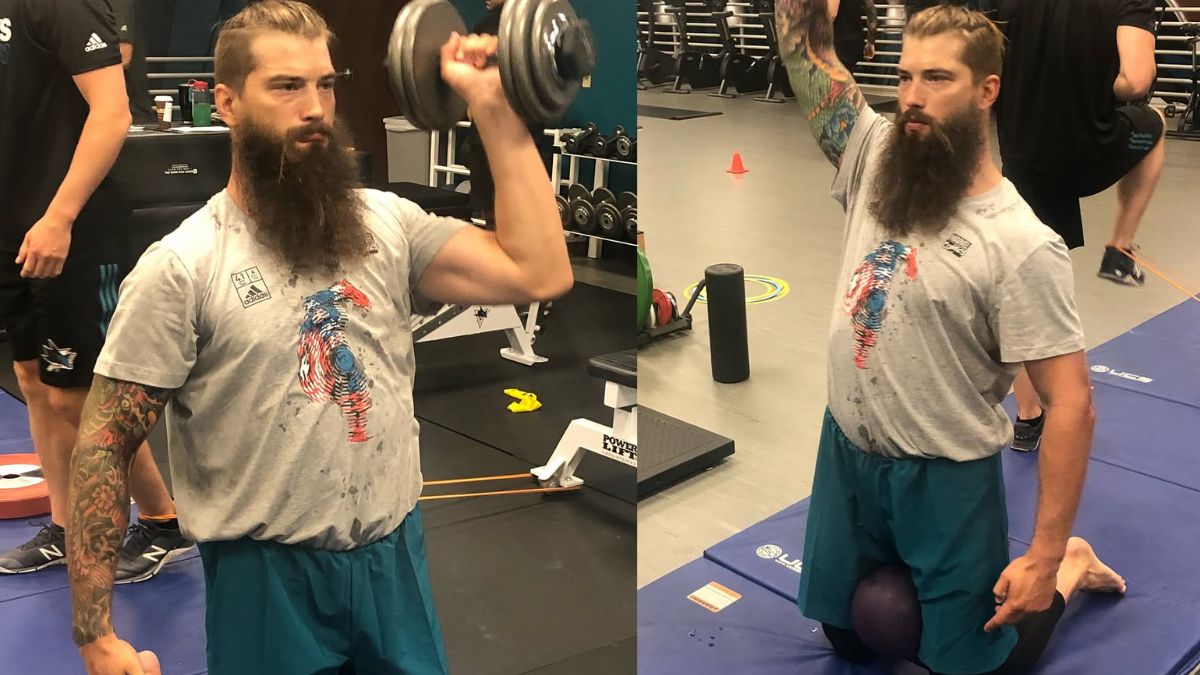
Brent Burns is not your typical NHL superstar. The bearded defenseman who has become one of hockey’s most recognizable figures combines elite athletic performance with an eccentric personality that makes him one of professional sports’ most fascinating characters.
At 41 years old, Burns continues defying expectations, recently becoming only the second player in NHL history to reach 1,000 consecutive games played. His journey from a forward convert to Norris Trophy-winning defenseman tells a story of adaptability, resilience, and an unrelenting passion for competition.
Beyond the rink, Burns lives a life that includes exotic animals, a devoted family, and interests that extend far beyond hockey. Understanding the complete Brent Burns requires looking at both the elite athlete and the unique individual who marches to his own beat.
Quick Profile
| Detail | Information |
|---|---|
| Full Name | William Brent Burns |
| Date of Birth | March 9, 1985 |
| Age | 41 years old (as of April 2026) |
| Birthplace | Barrie, Ontario, Canada |
| Height | 6’5″ (196 cm) |
| Position | Defenseman (originally drafted as Right Wing) |
| Current Team | Colorado Avalanche |
| NHL Debut | October 8, 2003 |
| Draft | 2003, 1st Round (20th overall) by Minnesota Wild |
| Nationality | Canadian |
| Wife | Susan Holder Burns |
| Children | Three (Peyton, Jagger, Robin) |
Early Life in Barrie, Ontario
Brent Burns was born on March 9, 1985, in Barrie, Ontario, a city about an hour north of Toronto. Growing up in this hockey-mad region of Canada, he was surrounded by the sport from an early age.
Barrie provided the perfect environment for developing hockey talent. The local minor hockey programs were competitive and well-organized, giving young players like Burns opportunities to develop their skills against quality competition.
His childhood included regular visits to zoos and wildlife facilities, planting the seeds for what would become a lifelong passion for animals. This interest seemed unrelated to hockey at the time but would later become a defining aspect of his personality.
The young Burns showed athletic versatility beyond hockey. His size, coordination, and competitive drive made him stand out in multiple sports, though hockey would eventually capture his complete focus.
Junior Hockey Development
Burns spent his early development years playing for the Barrie Icemen and Ajax Knights of the Ontario Minor Hockey Association. These formative years taught him fundamental skills and hockey IQ that would serve him throughout his career.
He also played in the Metropolitan Toronto Hockey League (now the Greater Toronto Hockey League) for the North York Canadiens, competing alongside future NHL players Anthony Stewart and Geoff Platt.
Burns played his Ontario Hockey League career as a right winger with the Brampton Battalion in the 2002-03 season, leading the team in playoff scoring that season with five goals and six assists in 11 games.
His OHL performance caught the attention of NHL scouts. He was runner-up for Most Improved Player in the OHL as voted on by league coaches, demonstrating rapid development that projected well for professional hockey.
Playing as a forward in junior hockey would prove significant later when NHL coaches sought his versatility in different positions.
NHL Draft and Position Conversion
Burns was drafted by the Minnesota Wild in the first round, 20th overall, in the 2003 NHL Entry Draft. The Wild selected him as a right wing based on his junior hockey position.
However, Minnesota’s coaching staff saw potential in converting him to defense. Upon turning professional with the Wild in 2003, Burns was converted to defense by defensively-minded Minnesota Head Coach Jacques Lemaire.
This position change could have derailed his career, but Burns embraced the challenge. Learning to play defense at the NHL level while simultaneously adjusting to professional hockey’s speed and physicality tested his adaptability.
He made his NHL debut with the Wild on October 8, 2003, against the Chicago Blackhawks, and scored his first NHL goal in his third game, against the Sharks.
The fact that following Marc-André Fleury’s retirement, Burns is the last active player in the NHL to have played in the league prior to the 2004-05 NHL lockout, having debuted in 2003-04, makes him a living connection to a different era of hockey.
Building a Career with Minnesota (2003-2011)
Burns’s early years with Minnesota involved learning his new position while contributing to a defensive-minded team. The 2004-05 lockout gave him additional development time in the AHL with the Houston Aeros.
By the 2006-07 season, he was emerging as a significant offensive threat from the blue line, scoring back-to-back overtime winners and showing the rushing ability that would define his style.
Injuries presented challenges. He suffered concussions that caused him to miss significant time, with one misdiagnosed as sinusitis for six weeks, raising health concerns and scrutiny of the Wild’s medical staff.
Despite setbacks, Burns developed into one of Minnesota’s top defensemen. His ability to contribute offensively while learning defensive responsibilities made him valuable, though his full potential remained untapped.
The Wild utilized him in various roles, sometimes shifting him back to forward when they needed offensive depth. This flexibility demonstrated his unique skill set but also indicated the team was still figuring out how to maximize his talents.
The San Jose Sharks Era (2011-2022)
Burns’s career reached new heights after being traded to the San Jose Sharks in June 2011. The move to California provided opportunities to play bigger minutes and embrace an offensive role.
During the shortened 2012-13 season and into 2013-14, the Sharks experimented with using Burns as a forward again. The versatility proved valuable, though ultimately the team determined his greatest impact came from the blue line.
Starting with the 2014-15 season, he was returned to defense, where he would establish himself as one of the NHL’s elite offensive defensemen.
His breakout came in 2015-16 when he finished with 75 points (27 goals, 48 assists), then had 24 points in 24 Stanley Cup Playoff games to help the Sharks reach the Final for the first time in franchise history.
On November 22, 2016, Burns signed an eight-year $64 million contract extension with the Sharks, cementing his status as a cornerstone player.
Norris Trophy and Peak Performance
In 2017, Burns won the James Norris Memorial Trophy as the league’s best defenseman. The award recognized his complete dominance as an offensive force who could also handle defensive responsibilities.
That season showcased everything that made him special—his skating ability, shot power, vision, and relentless motor that kept him involved in play after play.
He was also nominated for the Ted Lindsay Award, awarded annually to the league’s best player as voted by the NHLPL Players’ Association, demonstrating the respect he commanded from fellow players.
Burns became the face of the Sharks franchise during this period, appearing in multiple All-Star Games and representing the team as one of the NHL’s most recognizable personalities.
According to his statistics on Hockey Reference, he consistently averaged over 20 minutes of ice time per game and led all Sharks defensemen in virtually every offensive category during his 11 seasons with the team.
Read Also: Bobby Brink Biography: Height, Weight, Parents, Girlfriend & NHL Career Journey
Carolina Hurricanes Transition (2022-2025)
On July 13, 2022, the Sharks traded Burns and Lane Pederson to the Carolina Hurricanes in exchange for forward Steven Lorentz, goaltending prospect Eetu Mäkiniemi, and a third-round selection in the 2023 NHL Entry Draft.
The trade ended an unforgettable era in San Jose but gave Burns a chance to compete for a Stanley Cup with a championship-contending team in Carolina.
His time with the Hurricanes demonstrated that even in his late 30s, he remained an impact player. His experience, leadership, and offensive contributions helped Carolina reach deep playoff runs.
Burns adapted his game slightly, accepting reduced minutes while maintaining effectiveness. His willingness to embrace a different role showed maturity and team-first mentality.
Colorado Avalanche and Historic Ironman Achievement
On July 3, 2025, Burns signed a one-year contract with the Colorado Avalanche, joining another Cup contender in the Western Conference.
On October 11, 2025, Burns played his 1,500th NHL game, becoming the 23rd player to reach the milestone. The achievement highlighted his remarkable longevity and durability.
Even more impressive, Burns became the second player in NHL history to appear in 1,000 consecutive games when Colorado faced Dallas on Saturday April 4, 2026. The accomplishment puts him behind only Phil Kessel’s all-time record of 1,064 consecutive games.
Burns has been in the lineup for every game since November 21, 2013, with San Jose, spanning over 12 years without missing a single regular season contest.
Burns is in his first season with the Avalanche and has 11 goals, with he and Hall of Famer Nicklas Lidstrom being the only defensemen in league history to score double-digit goals at 40 or older.
Meeting and Marrying Susan Holder
Brent Burns is married to Susan Holder, with the couple meeting while attending Sam Houston State University and marrying in 2009. Their relationship formed the foundation for his personal life away from hockey.
Susan, born November 30, 1984, in Barrie, Ontario, completed her education at Sam Houston State University. While specific details about her career are not widely publicized, she has been described as working in the family’s real estate business and once working at eBay.
Their relationship has endured the challenges of NHL life—constant travel, relocations between cities, and the demands of an 82-game schedule plus playoffs. Susan’s support has been crucial to Burns’s ability to maintain his ironman streak while raising a family.
She describes herself on social media as a “Mama and hockey wife” who enjoys family time, running, and wine. Her Instagram account (@susanburns88) remains private, reflecting the family’s desire to maintain some privacy despite Burns’s public profile.
Susan has embraced the NHL wife role, connecting with other players’ spouses and supporting Burns’s career while managing family responsibilities. Her ability to handle his unique interests—including exotic animals—demonstrates patience and understanding.
View this post on Instagram
Building a Family: Three Children
Burns and Susan have welcomed three children: a daughter named Peyton Gabriann, born in March 2010, and two sons named Jagger Stephen Patrick, born in June 2011, and Robin, born in 2020.
The children have grown up in the NHL world, experiencing life in multiple cities as their father’s career took the family from Minnesota to California to North Carolina and now Colorado.
Burns has expressed the importance of family support throughout his career. Despite the demanding schedule, he prioritizes time with his wife and children whenever possible.
The kids have been exposed to their father’s love of animals from early ages. Burns wanted them around reptiles and exotic creatures so they wouldn’t develop the same fears he once had about snakes.
Raising three children while maintaining an NHL career and managing an exotic animal collection requires exceptional family coordination. Susan’s role in managing the household cannot be overstated.
The Burns Zoo: An Exotic Animal Collection
One of Brent Burns’s most distinctive characteristics is his passion for exotic animals. His suburban Saint Paul home is nicknamed “Burns Zoo” due to his collection of dogs, cats and dozens of reptiles, mainly snakes.
According to teammate accounts from ESPN, when Burns lived in Minnesota, two snakes escaped and were lost in his house for a period of time, causing concern among teammates who couldn’t believe he slept peacefully knowing massive snakes were roaming free.
The collection has been substantial. When he moved from Minnesota to San Jose in 2011, he reportedly had over 150 snakes, though he left most in Minnesota because he couldn’t move them all to a rental property in California.
Former teammate Marc-Edouard Vlasic joked that Burns had 400 snakes at one point, and Burns would take them to Detroit hotels, put them on the floor, and pet them during road trips.
Burns’s love for animals extends beyond snakes. He has owned exotic birds, turtles, pythons, and various other creatures. The Minnesota home featured a specially designed reptile room that was originally a bomb shelter, with double-locked doors to prevent escapes.
His ranch in Texas has allowed him to expand his animal interests to include larger creatures like elk and wildebeest. Burns has said that after hockey, he’d love to work at a zoo or in wildlife conservation.
The Cheetah Incident and Animal Adventures
One of the most famous Brent Burns stories involves a cheetah attack during a zoo visit. According to teammate accounts, Burns, Joe Thornton, and Colin White visited a zoo in Columbus on an off day, where Burns arranged to take a picture with a cheetah, which then clawed him in the ribs.
Teammates remember the incident with a mixture of horror and humor. The cheetah had its eyes on Burns the whole time during the photo setup, and when they got close, it reached over and grabbed him.
Burns’s reaction? Laughter. He wasn’t mad or concerned—just amused by the situation. This response perfectly encapsulates his personality: a big kid who loves animals and adventures regardless of minor dangers.
He would take teammates to snake farms in Detroit, zoos in various cities, and anywhere else with interesting animals during road trips. Not all teammates shared his enthusiasm, with some admitting terror at these excursions.
Physical Attributes and Playing Style
At 6’5″ and 230 pounds, Burns possesses ideal size for a modern NHL defenseman. His frame allows him to win board battles, block shots, and maintain positioning against opposing forwards.
What separates him is how he uses that size. Rather than playing a traditional stay-at-home defensive style, Burns developed into a rushing, offensive-minded defenseman who drives play up the ice.
His skating ability is remarkable for someone his size. He can carry the puck through the neutral zone, join rushes, and create offensive chances that smaller, more mobile defensemen typically provide.
His shot from the point is among the NHL’s most dangerous. The combination of velocity and accuracy makes him a power-play weapon who demands respect from penalty killers.
Defensively, he uses his reach and positioning rather than relying purely on physicality. His active stick and ability to read developing plays help him break up passes and rushes.
The Iconic Beard and Public Persona
Brent Burns’s wild, often unruly beard has become part of his identity. The thick, sometimes unkempt facial hair makes him instantly recognizable and adds to his mountain-man, free-spirit image.
Teammates describe him as a “big kid” who maintains childlike enthusiasm and curiosity about the world. This personality manifests in his interests, his approach to hockey, and how he interacts with others.
He’s known for carrying a large camouflage backpack—teammates call it his “Mary Poppins bag”—filled with various items and snacks. The bag has become legendary in NHL circles for its mysterious contents and substantial weight.
His intelligence surprises those who meet him. Teammates note he learns new skills and absorbs information remarkably quickly, as if downloading knowledge directly into his brain.
Despite his eccentricities, Burns is universally beloved in NHL locker rooms. His positive energy, team-first attitude, and genuine kindness make him an ideal teammate.
International Hockey Career
Burns has represented Canada in multiple international competitions. He was named the best defenseman at the 2008 World Championships as he helped Canada to a silver medal finish as the host country.
He participated in various World Championship tournaments, though he narrowly missed making Canada’s 2010 Olympic team despite being part of the summer camp roster.
In 2016, Burns won a World Cup of Hockey gold medal with Team Canada, adding an international championship to his resume. The tournament showcased his abilities on hockey’s biggest stage alongside Canada’s elite talent.
His international success demonstrates that his unique style translates against top competition from around the world, not just in NHL regular season play.
Career Statistics and Milestones
Burns’s career numbers reflect elite offensive production from the blue line. He entered a recent game with 941 points (272 goals, 669 assists) over 1,572 career regular-season games.
In January 2026, Burns scored the 270th goal of his career, tying Bobby Orr for 8th in goals by defensemen all-time. Reaching this milestone puts him in historic company among the greatest offensive defensemen ever.
He reached 600 assists in December 2023, becoming one of few defensemen to achieve that milestone. The accomplishment highlighted his playmaking ability beyond just goal scoring.
His consecutive games streak, now over 1,000 games, ranks among the most impressive durability achievements in NHL history, particularly given the physical demands of his playing style.
Net Worth and Financial Success
While exact figures aren’t publicly disclosed, Brent Burns has earned substantial wealth through his NHL career. His eight-year, $64 million contract with San Jose represented one of the league’s most lucrative deals for defensemen.
Subsequent contracts with Carolina and Colorado have added millions more to his career earnings. Over two decades in the NHL, his cumulative salary likely exceeds $100 million before taxes and agent fees.
Beyond salary, he likely earns additional income through endorsements, though he maintains a lower commercial profile than some NHL stars. His focus appears more on hockey and personal interests than maximizing off-ice income.
His investments in property, including the ranch in Texas with exotic animals, represent significant assets. Managing wildlife facilities and land requires substantial financial resources.
Read Also: James Hagens Biography: Family, NHL Draft, Boston College Career & Life Story
About The Author