
Women’s tennis has spent the last few years searching for the next generation of American stars. The focus often lands on the obvious names—the teenage phenoms with Instagram followings, the players who win junior Slams before they’re old enough to drive. Ashlyn Krueger doesn’t fit that narrative, and that might be exactly why she’s worth watching.
she’s reached a career-high ranking of No. 29 in July 2025. That happened not through viral moments or hype campaigns but through something less sexy and more sustainable: showing up, competing consistently, and gradually getting better at beating players she used to lose to.
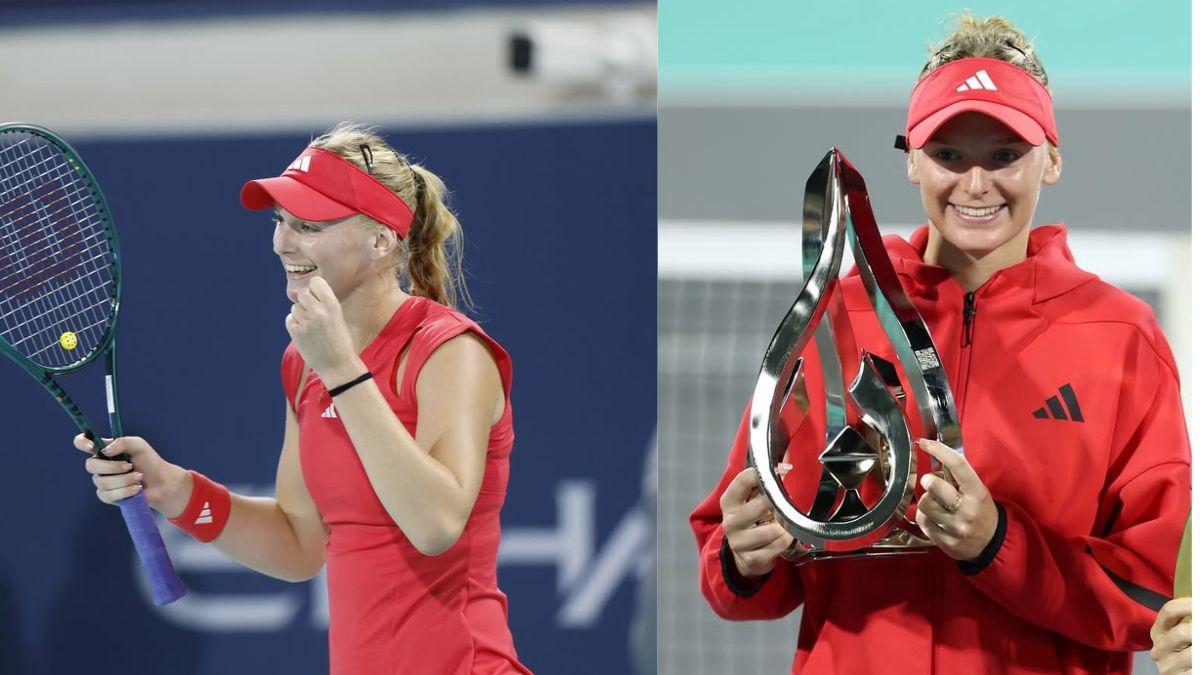
Her 2025 season demonstrates this perfectly. She started the year at the Brisbane International reaching the quarterfinals, then did it again the following week in Adelaide. At the Abu Dhabi Open in February, she made her first WTA 500 final, defeating Daria Kasatkina and Leylah Fernandez along the way before losing to Belinda Bencic.
These aren’t headline-grabbing Grand Slam runs. They’re the kind of steady progress that separates players who stick around from those who flame out after early promise.
How Tennis Became Her Path
She was born May 7, 2004, in Dallas, Texas. Her mother Franchel played college tennis at Iowa State in the 1990s, so the sport was already part of the family when Ashlyn came along.
According to a 2022 interview with The Dallas Morning News, her family moved to Texas when she was around 8, and she started practicing at Brookhaven Country Club. But it wasn’t until she was 12 or 13 that tennis became more than just an activity—it became a commitment.
Her mother Franchel told the newspaper: “If there’s one thing I can say about Ashlyn, even before, it’s always been her driving the ship. I’ve never, her dad’s never had to say, ‘OK, can you practice today? You need to do more.’ She never complains about going to practice.”
That internal drive matters more than people realize. Plenty of talented kids get pushed into sports by ambitious parents. Fewer arrive at that ambition themselves and sustain it through the boring parts—the repetitive drills, the travel grind, the losses that sting for days.
She has a younger sister named Avery. Her father’s background isn’t extensively documented publicly, but the family environment clearly supported athletic development without forcing it.
From Junior Success to Professional Reality
Her junior career had the right markers. She won the Orange Bowl U16 title in 2019, then came back and won the U18 division in 2020, becoming the first player since Bianca Andreescu to win both age divisions in consecutive years.
In August 2021, she won both singles and doubles at the USTA National Championships, earning wild cards into the US Open. She turned professional that month at 17, making her debut at the US Open where reality hit quickly—she lost in the first round.
That’s the gap nobody talks about enough. Junior tennis and professional tennis are different sports that happen to use the same equipment. Junior success predicts almost nothing about professional outcomes except that someone has talent worth developing.
She moved to the USTA National Campus in Lake Nona, Florida, training with coach Michael Joyce, a former ATP player who has coached Maria Sharapova and others. The training environment matters—being around other professionals, working with experienced coaches, having access to proper facilities and support staff.
Building Without Breaking Through
Her first WTA title came in September 2023 at the Japan Women’s Open in Osaka. She didn’t drop a set all week, defeating Zhu Lin in the final. The win pushed her into the top 100 for the first time at No. 73, making her the seventh American to debut in the top 100 that year.
That title came after years of grinding through ITF tournaments, WTA 125 events, and qualifying rounds at bigger tournaments. She won a WTA 125 title in Gaiba, Italy, earlier that year. These lower-level events don’t get coverage, but they’re where players develop the skills and confidence needed for the main tour.
In 2024, she made the main draw at all four Grand Slams for the first time. Her best result was reaching the third round at the US Open, where she defeated Zhang Shuai and upset world No. 21 Mirra Andreeva before losing to Liudmila Samsonova.
She also won her first WTA doubles title that year, partnering with Sloane Stephens at the Charleston Open. They defeated the top-seeded Ukrainian sisters Lyudmyla and Nadiia Kichenok in the final.
Her Game: Size, Power, Completeness
Standing 6’1″ (185 cm), she has the physical tools that modern baseline tennis rewards. Her height generates natural leverage on serves and groundstrokes. She hits a two-handed backhand and plays right-handed.
Coach Dave Anderson, who worked with her at Brookhaven, told The Dallas Morning News: “Ashlyn has one of the most complete games I believe out on the WTA Tour.”
That assessment matters because “complete game” means no obvious technical weakness opponents can exploit. She doesn’t have one dominant weapon like a massive serve or superhuman speed. Instead, she’s solid everywhere—good serve, strong groundstrokes from both wings, decent movement, improving net skills.
Jessica Pegula, the world No. 3, practiced with her and said: “There’s so many good players in American tennis and I feel like she has a really good shot to be one of the better players just because she handles herself on court really well. She’s got a really nice, quiet kind of maturity about her.”
That “quiet maturity” might be her biggest strength. Tennis rewards players who stay emotionally level through momentum swings. Players who don’t implode after losing the first set. Players who grind through tight third sets without panicking.
The 2025 Surge and What It Means
Her 2025 season represents a step forward. According to her official WTA profile, she reached her first WTA 500 final at Abu Dhabi and hit a career-high ranking of No. 29 on July 14, 2025.
At the Miami Open in March 2025, she reached the fourth round of a WTA 1000 for the first time, defeating Elena Rybakina for her first top-10 win. That victory matters because beating elite players is different from beating good players. The margin for error shrinks, and you have to execute under pressure against opponents who don’t give away points.
She’s currently ranked No. 61 as of January 2026 after some inconsistent results following that strong early-season run. That ranking fluctuation is normal for players in this development phase—they string together good results, the ranking jumps, then they face tougher draws and lose matches they might have won months earlier.
The question isn’t whether she’s arrived. It’s whether she can sustain the level she showed in early 2025 and build on it.
Money, Expectations, and Reality
According to publicly available prize money data, she has earned approximately $2.5 million in career prize money as of early 2026. Her estimated net worth sits around $500,000 based on tennis earnings and potential endorsement deals, though exact figures aren’t confirmed.
Her equipment sponsor is Yonex. Beyond that, public information about endorsement deals is limited, suggesting she hasn’t yet reached the threshold where major brands compete for her representation.
This financial reality shapes career decisions. She needs to keep winning matches to maintain her ranking and keep earning. Unlike established stars with guaranteed appearance fees and multi-million dollar endorsement portfolios, she’s still building financial security match by match.
Life Beyond Match Results
She shares some glimpses of her personality on Instagram (@ashlynrosekrueger). That’s modest for a professional athlete—a fraction of what top players or even highly ranked players with strong social media presences have.
She enjoys drawing and reading poetry in her spare time according to earlier interviews, interests that suggest someone comfortable with solitude and introspection. These aren’t the typical athlete hobbies that get mentioned in profiles, which makes them worth noting—they hint at someone who has interests beyond just tennis.
Her personal life remains private. There’s no public information about relationships or dating, which is her choice and should be respected. She focuses her public presence on tennis rather than lifestyle content.
She relocated from Texas to train at the USTA Campus in Florida, a significant life change that separated her from family and the environment she grew up in. That choice shows commitment—uprooting your life for training optimization isn’t easy, especially for someone who was still a teenager when she made the move.
Common Questions
How old is Ashlyn Krueger?
She was born May 7, 2004, making her 21 years old as of January 2026.
What is her playing style?
She’s an all-court player who relies on solid fundamentals rather than one dominant weapon. At 6’1″, she uses her height advantage on serves and groundstrokes. Her game emphasizes consistency and completeness rather than overwhelming power.
Has she won any WTA titles?
Yes, she won the 2023 Japan Women’s Open (WTA 250) in singles and the 2024 Charleston Open (WTA 500) in doubles partnering with Sloane Stephens.
Who coaches her?
Her current coach is Michael Joyce, a former ATP player who has worked with other top players including Maria Sharapova.
Read Also: Christian Coleman: Sprint Career, Achievements, Setbacks, and Personal Background
About The Author