
Aleix García is the Spanish midfielder who proves that the straightest line between potential and success doesn’t always exist in football. While teammates from Manchester City’s academy moved directly into Europe’s elite, García spent a season in Romania wondering if his career had stalled permanently.
Born June 28, 1997, in Ulldecona, a small town in Tarragona, Catalonia, Aleix García Serrano is a Spanish professional footballer who plays as a central midfielder for Bundesliga club Bayer Leverkusen and the Spain national team. At 28 years old, he stands just 1.73 meters (5 feet 8 inches) tall—unusually small for a modern midfielder, yet his technical brilliance makes height irrelevant.
His journey reads like a cautionary tale that somehow turns into a success story. From Villarreal’s academy to Manchester City’s reserves, through loan spells in Belgium and Romania, before finally finding himself at Girona where he became captain and led them to their first-ever Champions League qualification. Now he plays for Bayer Leverkusen in the Bundesliga and represents Spain internationally.
Early Life
Born in Ulldecona, Tarragona, Catalonia, García joined Villarreal CF’s youth setup in 2005, aged eight, after starting out at CF Ulldecona. Ulldecona is a small Catalan town with roughly 6,000 residents, nestled near the Mediterranean coast in Spain’s northeastern corner.
Growing up in Catalonia shaped everything about his football identity. The region’s philosophy emphasizes technique over physicality, intelligence over athleticism, and collective play over individual brilliance. These values would define García’s playing style throughout his career.
His family recognized his talent early and supported the decision to join Villarreal’s academy at just eight years old. This meant regular travel from Ulldecona to Villarreal for training—a significant commitment for both the young player and his parents.
Specific details about his parents, their professions, or whether he has siblings remain private. García has consistently maintained strong boundaries between his public football career and his family’s privacy, rarely discussing personal background in interviews.
Parents, Family and Hometown Roots
While García keeps his immediate family out of the spotlight, he has mentioned staying connected to his hometown despite his professional success. When asked about Ulldecona, García said: “Until recently, my uncle was the coach of the first team at Ulldecona, and my cousin plays there. I can’t attend matches, but I keep track of their progress”.
This connection reveals a close-knit family still involved in local football. His uncle coaching the town team and his cousin playing there suggests football runs in the García family, though the sport clearly reached different professional levels for Aleix.
The privacy surrounding his parents’ identities and occupations is deliberate. Many European footballers, particularly those from smaller towns, protect family members from media attention while they themselves accept public scrutiny as part of professional sports.
What’s clear is that his family provided the support structure necessary for a young boy to leave home regularly for elite academy training—a sacrifice that eventually paid off, though not through the path anyone initially expected.
Ethnicity, Cultural Background and Religion
Aleix García is ethnically Catalan, representing Spain’s distinct cultural and linguistic region in the northeast. Catalonia maintains its own language, traditions, and strong regional identity that often distinguishes itself from broader Spanish culture.
His name is pronounced [əˈleʒ ɣəɾˈsi.ə] in Catalan and [aˈleʃ ɣaɾˈθi.a] in Spanish, highlighting the linguistic differences between Catalan and Castilian Spanish pronunciation. His first name “Aleix” is the Catalan version of “Alex” or “Alexis.”
His Catalan heritage shapes his football philosophy. The region produced Barcelona’s famed tiki-taka style, emphasizing possession, short passes, and technical supremacy. While García plays for Spain’s national team rather than advocating for Catalan independence, his regional identity influences his playing style.
Regarding religion, García has not publicly discussed spiritual beliefs, faith traditions, or religious practices. Like many modern European footballers, he appears to keep this aspect of life private, separating personal beliefs from professional identity.
His public persona focuses entirely on football, with social media content centered on training, matches, and team activities rather than cultural, political, or religious messaging.
Youth Development at Villarreal
He made his senior debut with the reserves in Segunda División B on 26 April 2014 at only 16 years of age, coming on as a late substitute in a 1–0 away win against CF Badalona. Making a senior debut at 16 demonstrated precocious talent and maturity beyond his years.
He then spent the following 12 months bouncing between the B and C sides before making his first-team debut in May 2015 as a LaLiga substitute. His first-team appearance came in a 4-0 loss at Athletic Bilbao on May 23, 2015—not a memorable result, but a personally significant milestone.
That single LaLiga appearance for Villarreal’s first team would be his only one. Just months later, Manchester City arrived with an offer that promised a faster route to European football’s elite.
The Manchester City Dream That Didn’t Work Out
On 27 August 2015, García joined Premier League side Manchester City. For an 18-year-old from a small Catalan town, joining one of Europe’s wealthiest and most ambitious clubs represented a dream realized.
He was never a regular there, although he did amass eight appearances, scoring once. His goal came in an EFL Cup match against Swansea City on September 21, 2016, in a 2-1 away victory—a moment of promise that never developed into consistent first-team football.
When Pep Guardiola arrived as City manager in 2016, García hoped his Catalan background and technical style might help him break through. After a 5-1 win over Huddersfield, Guardiola praised him: “Aleix played really well tonight. He was a little bit shy at the beginning, but he’s a player with something special. I’m really pleased with his performance”.
Despite Guardiola’s public praise, García couldn’t break into a midfield containing David Silva, Kevin De Bruyne, and Fernandinho. The loan cycle began—a pattern that would define the next five years of his career.
The Difficult Years: Loans Across Europe
On 1 August 2017, García was loaned to newly promoted La Liga club Girona FC until the end of the season. He was loaned again for the 2018–19 season. These two seasons at Girona gave him regular first-team football in Spain’s top division, playing 51 LaLiga matches and showing flashes of the player he could become.
But Manchester City still didn’t see a future for him. García was loaned to Belgian side Royal Excel Mouscron for the 2019–20 season. The Belgian experience was less successful and failed to provide the platform he needed to prove himself worthy of City’s first team.
Then came the lowest point. On 8 October 2020, he signed a contract with Romanian club Dinamo București, until the end of the season. This wasn’t even a loan—City released him, and he signed with Romania’s Liga I on a free transfer.
For a player once considered Manchester City’s future, playing in Bucharest represented rock bottom. He featured sparingly, the level was significantly lower than what he’d known, and his dream of elite European football seemed finished at just 23 years old.
When asked about his time in Belgian and Romanian leagues, García reflected: “They were phases I never thought I would experience. I consider those seasons very important because they made me mature and realize what I needed to change to play at the level I am now”.
Read Also: Kenyon Sadiq Biography: Family, NFL Draft Journey, Height & Personal Life
The Resurrection: Finding Home at Girona
On 18 January 2021, after featuring sparingly at Dinamo, he returned to Spain and its top tier after signing for Eibar on a free transfer. Eibar was relegated that season, but García had found his way back to Spanish football and regular playing time.
On 23 July 2021, García returned to Girona on a two-year contract, with the club now in Segunda División. This permanent move to Girona—where he’d previously succeeded on loan—proved transformative.
He helped Girona earn promotion back to LaLiga in 2022. Then came the magical 2023-24 season that nobody saw coming.
On 26 February 2023, García opened the score in a historic 3–2 La Liga win over Athletic Bilbao, Girona’s first ever win away against Bilbao at San Mamés. He was becoming not just a player but a leader and club legend.
García played in all but one of Girona’s 38 LaLiga fixtures last season, wearing the captain’s armband for more than two thirds of those encounters. Girona finished third in LaLiga—ahead of Atletico Madrid and Barcelona—qualifying for the Champions League for the first time in club history.
Former Barcelona manager Xavi noticed. In December 2023, he said: “He’s a footballer that I like, he’s having a huge season. He has a lot of technical ability and the level to play here, to play for Barcelona”.
Bayer Leverkusen: Proving Himself in the Bundesliga
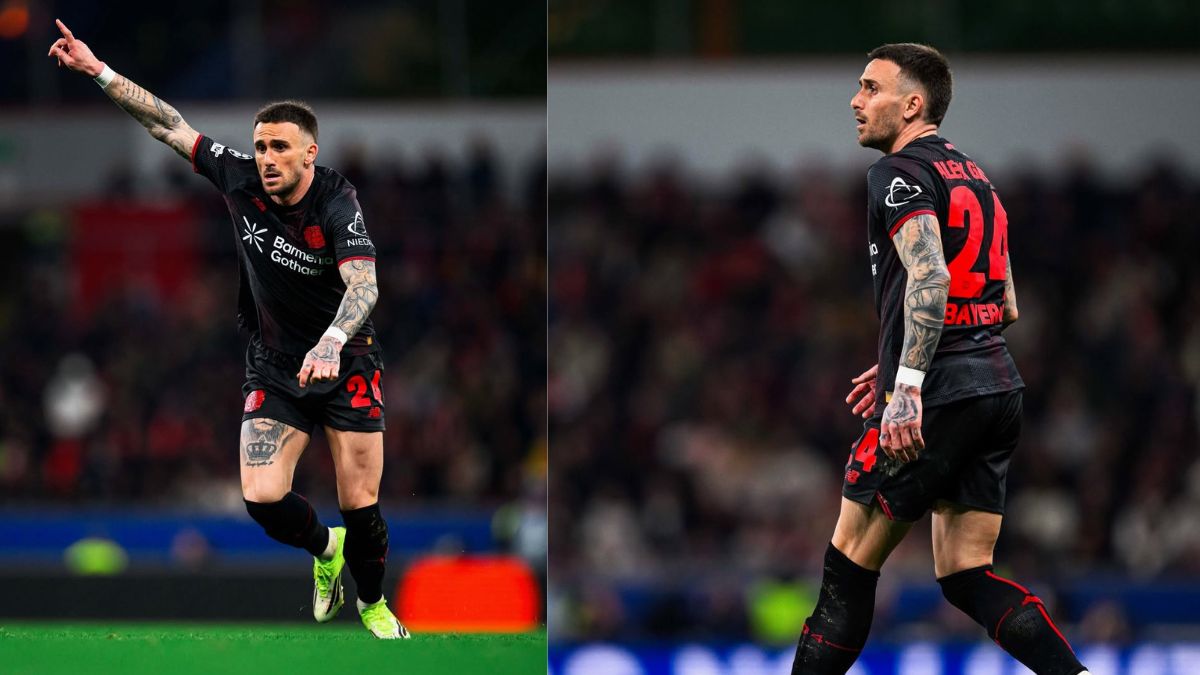
On 13 June 2024, after his successful season captaining Girona, Garcia moved to Bayer 04 Leverkusen for more than €18 million. Leverkusen had just completed an unbeaten Bundesliga season under Xabi Alonso, winning their first-ever league title, and García joined as a key midfield addition.
The move to Germany presented new challenges—different culture, different language, different tactical demands. When asked about his transition to Leverkusen, García said: “When you change country and culture, it always takes a bit of adjustment, but the coach is Xabi Alonso, and I’m fortunate that Spanish is spoken in the Leverkusen locker room”.
In the 2025/2026 Bundesliga season, Aleix García has recorded 1 goal, 5 assists, 2,031 minutes, an average FotMob rating of 7.41, and 4 yellow cards. He’s established himself as an important player in Alonso’s possession-based system, proving he belongs at this level.
You can follow his current performance statistics at fotmob.com.
Spain National Team: International Recognition
On 10 November 2023, he was called up for the senior national team for the upcoming UEFA Euro 2024 qualifying matches. On 16 November, he made his debut in a 3–1 away win over Cyprus, finally achieving international recognition after years of struggle.
He became the first-ever Girona player to play for the Spanish national side—a historic achievement for both player and club that validated his resurrection from the Romanian leagues.
On 27 May 2024, he was selected in the 29-man preliminary squad for UEFA Euro 2024. However, on 7 June, he was excluded from the final squad prior to the tournament. Missing Euro 2024 was disappointing, especially as Spain went on to win the tournament.
Despite the Euro 2024 exclusion, García remains focused on the future. “Playing in the 2026 World Cup is one of my objectives,” García told Mundo Deportivo. “I see myself capable. I’ve been consistently called up to the national team, and my goal is to be at that World Cup in 2026”.
Physical Attributes and Playing Style
Standing just 1.73 meters (5 feet 8 inches) tall and weighing approximately 68 kilograms (150 pounds), García is noticeably smaller than most modern central midfielders. But what he lacks in physical presence, he compensates for with technical brilliance and football intelligence.
His game is built on quick passing, spatial awareness, and the ability to control tempo. He excels in tight spaces, rarely loses possession, and dictates rhythm from central midfield positions. His small stature actually helps—he has a low center of gravity that makes him difficult to dispossess.
Defensively, he compensates for lack of height with positioning and anticipation rather than physical duels. His reading of the game allows him to intercept passes and break up opposition attacks before they develop.
Personal Life and Relationships
Aleix García maintains extreme privacy regarding his romantic life and relationships. There is no publicly available information about a girlfriend, wife, partner, or dating history in Spanish, German, or international media.
His social media presence focuses exclusively on football—training photos, match highlights, team celebrations, and occasional sponsorship content. Personal relationship content is completely absent, suggesting a deliberate choice to keep romantic life separate from his public persona.
At 28 years old, whether he’s single, dating, or in a long-term relationship remains unknown and unreported. Unlike some footballers who share personal moments with partners on social media, García maintains a strict professional-only online presence.
This level of privacy is increasingly rare among modern athletes, but García appears committed to letting his football speak for itself without personal drama or publicity.
Net Worth and Financial Earnings
Aleix García’s exact net worth is not publicly disclosed, as is common for European footballers who aren’t in the superstar category. However, his financial situation can be estimated based on career earnings and current contract.
His transfer to Bayer Leverkusen for over €18 million in 2024 came with a contract running through June 2029. Players at top Bundesliga clubs like Leverkusen typically earn annual salaries between €2-5 million, depending on their experience and importance to the team.
Conservative estimates place García’s net worth between €3-6 million (approximately $3.2-6.5 million), accumulated through:
- Manchester City youth and reserve team salaries (2015-2021)
- Loan salaries from Girona, Mouscron, and others
- Permanent contracts at Dinamo București, Eibar, and Girona
- Current Bayer Leverkusen salary
- Potential sponsorship and endorsement deals
His wealth will grow significantly if he maintains his starting position at Leverkusen and secures a spot in Spain’s 2026 World Cup squad. International tournament exposure typically leads to improved contract negotiations and commercial opportunities.
Compared to superstar footballers earning €10-30 million annually, García’s earnings are modest. But for a player who spent time in Romania’s league just five years ago, his current financial situation represents remarkable success.
Read Also: Eli Stowers Biography, Age, Height, College Career, Awards & NFL Draft
About The Author