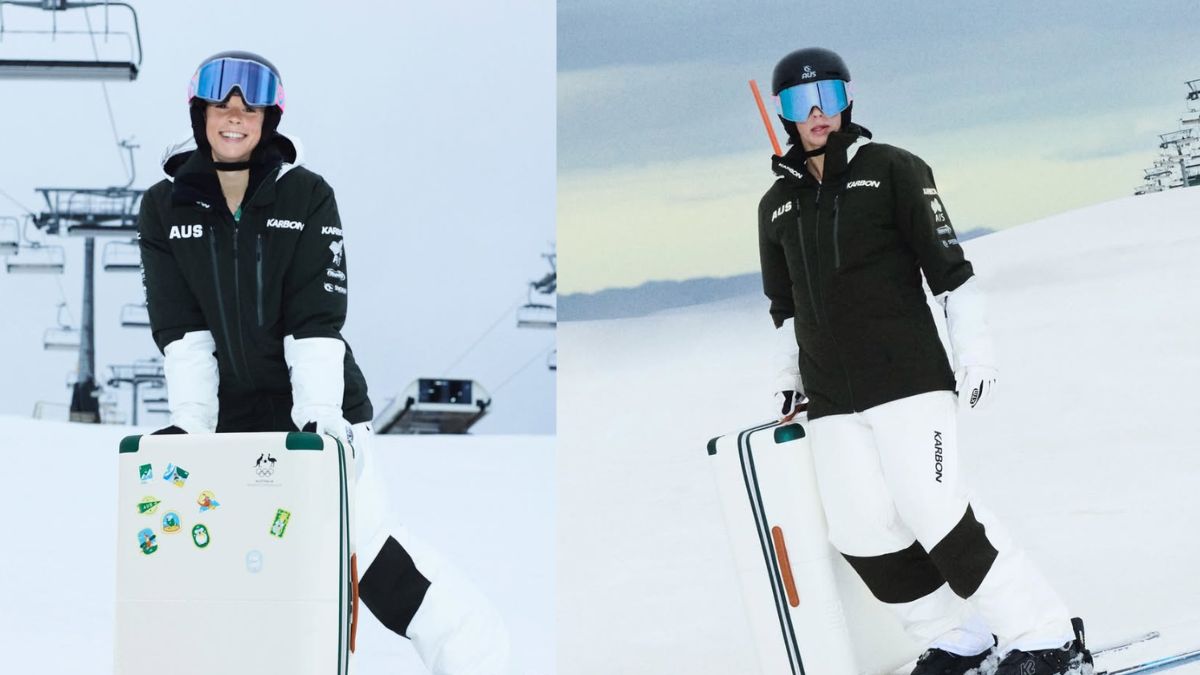
Jakara Anthony is Australia’s most successful freestyle skier and a two-time Olympic gold medalist. After winning moguls gold at Beijing 2022, she captured dual moguls gold at Milano Cortina 2026, becoming the first-ever Olympic champion in the event’s debut and she joined an elite group of Australian Winter Olympic champions by winning her second career gold medal
Her career includes 26 World Cup victories—the most in Australian winter sports history across any discipline—and 42 World Cup podiums. Her path began on Mount Buller where her parents met, leading to a childhood split between winters training on snow and summers in Barwon Heads. From making her World Cup debut at 16 to winning two Olympic golds by age 27, her journey represents technical mastery, aerial innovation, and resilience under pressure.
Quick Facts About Jakara Anthony
| Category | Details |
|---|---|
| Full Name | Jakara Anthony OAM |
| Date of Birth | July 8, 1998 |
| Age | 27 years old (as of 2026) |
| Birthplace | Cairns, Queensland, Australia |
| Hometown | Barwon Heads, Victoria |
| Height | 5’7″ (1.70 m) |
| Sport | Freestyle Skiing (Moguls) |
| Nickname | Jak |
| Parents | Daryn Anthony (father), Sue Johnson (mother) |
| Siblings | Matt Anthony (younger brother) |
| Olympic Medals | 2 Gold (2022 Beijing Moguls, 2026 Milano Cortina Dual Moguls) |
| World Championships | 1 Silver (2019) |
| World Cup Wins | 26 (Australian record across all winter sports) |
| Crystal Globes | 7 total |
| Education | Deakin University (Exercise and Sport Science) |
| Honours | Medal of the Order of Australia (OAM, 2022) |
Parents and Family Background
Jakara’s parents are Daryn Anthony and Sue Johnson. They met in the mid-1990s on the slopes of Mount Buller in Victoria—a meeting that shaped their daughter’s future. Both worked as seasonal workers at the mountain resort, spending winter months skiing and working before returning to their home base for summer.
Her father Daryn and mother Sue created an unusual childhood structure for their children. During winter months, the family lived at Mount Buller where Jakara and her younger brother Matt attended primary school on the mountain while being immersed in skiing culture. When summer arrived, they relocated back to Barwon Heads on Victoria’s Bellarine Peninsula for the warmer months.
This biannual migration meant Jakara grew up with two homes and two distinct lifestyles—the snow-covered alpine environment where skiing was everything, and the coastal beach town where she could live a more conventional childhood. Her parents’ commitment to this arrangement required significant logistical planning and sacrifice but gave their children unprecedented access to world-class ski facilities.
Her younger brother Matt, born just over a year after Jakara, also participated in skiing during their childhood years on the mountain.
Early Life and Barwon Heads
Born July 8, 1998 in Cairns, Queensland, Jakara moved to Barwon Heads, Victoria during pre-school when her family established their permanent residence there. Barwon Heads is a small coastal town on the Bellarine Peninsula, about 100 kilometers southwest of Melbourne.
The town provided a normal childhood environment away from skiing—beaches, local schools, and community connections. But every winter, the family would pack up and move to Mount Buller for the ski season, creating a dual existence that defined her early years.
She began skiing at age four, starting on the slopes where her parents worked. By this age, most Olympic skiers have already started their sport, but Jak’s introduction was organic rather than planned—she simply grew up around snow and skiing became natural.
For the first seven years of skiing, she participated in Victorian Interschools competitions across all snow disciplines—both skiing and snowboarding. She tried everything before specializing, gaining broad experience that would later contribute to her versatility as a moguls skier.
Joining the Moguls Program
At age 11, Jakara made the decision that would define her athletic career—she joined Mount Buller’s moguls program, Team Buller Riders. This meant committing specifically to moguls skiing and leaving behind the variety of disciplines she’d tried as a younger child.
The moguls program required serious dedication. Training involved mastering three distinct components: navigating bumps at high speed while maintaining perfect upper body control, executing aerial tricks off jumps mid-run, and maintaining maximum speed throughout. Each component required years of practice to perfect.
Her inspiration came from watching Australian Olympian Britt Cox, who competed at the 2010 and 2014 Winter Olympics in moguls. Seeing another Australian woman succeed in the sport made the Olympic dream feel achievable rather than abstract.
She rose rapidly through national ranks, showing talent that stood out even among other committed young skiers. In 2012, at age 14, she earned selection to the Australian Development Team—the pathway program for identifying and nurturing future Olympians.
International Debut and Early Career
At age 12, Jakara competed internationally for the first time, gaining exposure to competition outside Australia. These early international experiences taught her what racing at elite levels required and what standards she needed to meet.
In 2015, at just 16 years old, she made her World Cup debut at Deer Valley, Utah—one of the premier moguls venues in the world. She finished 33rd, a respectable result for a teenager competing against the world’s best. This debut marked her official arrival on the international stage.
The 2016-17 season showed improvement. At Tazawako, Japan, she cracked the top 10 in a World Cup event—a signal that she was ready for world-stage competition. Top-10 finishes at World Cup events separate developing athletes from established competitors.
In 2017, she made her World Championships debut, finishing 12th overall in moguls. World Championships happen every two years and represent the sport’s highest level outside Olympics, so this performance at age 18 demonstrated readiness for major championships.
PyeongChang 2018 Olympics
Heading into her first Olympics at age 19, Jakara was still developing but showing promise. In January 2018, just weeks before PyeongChang, she achieved a personal-best fifth-place finish at the Deer Valley World Cup, reaching the super-final for the first time in her career.
At PyeongChang 2018, she entered as the 14th seed. She finished 14th in her first qualifying round, advancing to the second qualifying round with 69.49 points. This placed her in position to reach the finals.
In the finals, she progressed to her second-ever super-final—the final six competitors who battle for medals. She finished fourth with a score of 75.35, only 2.05 points behind bronze medalist Yuliya Galysheva and 3.30 points behind Olympic champion Perrine Laffont.
Fourth place at the Olympics is heartbreaking—so close to a medal yet finishing without one. But for Australian women’s moguls, this was the best Olympic result in history to that point. She finished ahead of compatriot and defending world champion Britt Cox by 0.27 points. Despite the disappointment, she was pleased, noting it was her personal best across all events in her career so far.
Breakthrough 2018-19 Season
The 2018-19 season marked Jakara’s breakthrough into elite status. She won her first World Cup medal in Thaiwoo, China, then captured her first World Cup victory at Lake Placid—one of the sport’s most prestigious venues.
At the 2019 World Championships in Deer Valley, she qualified first overall, showing she could dominate qualification rounds. In the finals, she won silver behind Kazakhstan’s Yuliya Galysheva—her first major championship medal and confirmation she belonged among the world’s best.
Beijing 2022 Olympic Gold
The COVID-19 pandemic disrupted the 2020-21 season, but Jakara’s preparation for Beijing 2022 continued. Her aerial progression became crucial—she worked extensively on the newly installed aerial water ramp facility in Brisbane, which she called “game-changing” for Australian moguls development.
During qualifications at Beijing, she finished first overall—a significant psychological advantage heading into finals. Unlike PyeongChang where she was 14th seed, she now entered as the top qualifier.
As documented by the Australian Olympic Committee, the waiting period between qualification and finals felt “tough” due to COVID restrictions preventing athletes from training on snow until competition day. But once training began, she felt confident: “we’re on here, I can do this.”
In the first finals round, she finished top with an 81.91-point run. In the second finals round, she again finished first with 81.29 points. As the last skier in the super-final, she described entering a “state of flow” during her final run, knowing it was gold-medal quality from the moment she finished.
Her score of 83.09 made her Olympic champion, 2.81 points ahead of American Jaelin Kauf. She became Australia’s sixth Winter Olympic Games gold medalist and the first Australian Winter Olympic champion since 2010—ending a 12-year drought.
Her victory featured a “cork 720 mute” aerial trick—the most difficult jump in the women’s event and the first time a woman landed it at an Olympic Games. This technical innovation demonstrated her commitment to progression, not just executing established tricks but pushing boundaries.
Fellow Australian Olympic champions Alisa Camplin and Lydia Lassila attended the final. Camplin, who mentored Jakara at the Olympics, praised her for being “steely under pressure.” Lassila highlighted her “controlled” performance and “pure dominance” over the competition.
Read Also: Clark Gilbert Biography: Family, Personal Life and LDS Church Leadership
Record-Breaking 2023-24 Season
The 2023-24 season was extraordinary by any standard. Jakara won 14 World Cup events from 16 starts—a single-season record in women’s moguls. She swept all three Crystal Globes: single moguls, dual moguls, and overall points.
When she arrived back in Australia after the season finale in Valmalenco, Italy, she joked about having “big luggage issues” getting three Crystal Globe trophies home. When asked about her next goal, she stated her focus was achieving a World Championship title—her only missing major title.
Her 21 total World Cup victories by season’s end left her three behind the all-time Australian record held by aerial skier Jacqui Cooper (25 career wins). Media coverage from Australian Women’s Weekly documented her rise as Australia’s greatest chance for gold at Milano Cortina 2026.
Reflecting on the record-breaking season, she said: “It was the longest season I’ve ever competed in with 16 starts… it was really about taking it literally one run at a time and trying to not get too far ahead of ourselves.”
Collarbone Injury and Recovery
At the start of the 2024-25 season, Jakara continued her podium streak with silver at Ruka, Finland—her 42nd career World Cup podium, making her the most successful Australian winter athlete in FIS World Cup history, breaking aerial skier Kirstie Marshall’s record.
At Idre Fjäll, Sweden, she won again, marking her 23rd career World Cup victory. Then disaster struck. During a training session before the dual moguls event, she sustained a broken collarbone. She underwent surgery in Oslo and missed the rest of the season, returning home to Australia.
The injury ended an incredible run of form—she had won 15 of the past 18 overall moguls events before the injury. During recovery, she acted as a prominent athlete promoting the 2026 Winter Olympics in Australia.
Her patience during rehabilitation, watching teammates and rivals compete while she recovered, required mental toughness. But she returned to competition for the 2025-26 World Cup season and immediately returned to winning form.
On December 8, 2025, almost exactly a year after her injury, she won the Ruka World Cup moguls with a score of 79.89—proof that recovery was complete.
At Val Saint-Côme, Canada, she won again. Then at Waterville Valley, she claimed her 26th career World Cup victory, surpassing Jacqui Cooper’s record of 25 to become the most successful Australian winter sport athlete in any discipline in World Cup history.
View this post on Instagram
Milano Cortina 2026 Olympics
Jakara arrived at Milano Cortina 2026 as the world number one and heavy favorite. Australia selected her as one of two flag bearers at the Opening Ceremony alongside Eddie Ockenden—recognition of her status as Australia’s top Olympic gold medal hope.
She had two medal opportunities at these Games—the traditional moguls event where she was defending champion, and the new dual moguls event making its Olympic debut.
Moguls Final
On February 11, 2026, she competed in the moguls final at Livigno, attempting to become the first woman to win back-to-back Olympic gold medals in moguls. The course was notably steep at 28 degrees—steeper than typical moguls courses.
She topped qualification with a score of 81.65, entering the finals as the first seed. She also led after the first final round when the field was narrowed from 20 to 8 competitors.
During her final run in the super-final, she slipped on her first jump—a rare error that cost crucial points. Despite recovering to complete the run, she finished eighth. Team USA’s Elizabeth Lemley won gold with 82.30 points, with Jaelin Kauf taking silver (80.77) and Perrine Laffont bronze (78.00).
The disappointment was visible, but she handled the setback with composure. Fellow Australian Olympian Jess Fox, the canoe slalom champion, offered support publicly, showing the tight-knit nature of Australian Olympic athletes.
Dual Moguls Gold
Three days later, on February 14, 2026, Jakara got her redemption. In the Olympic debut of dual moguls—a head-to-head format where skiers race side-by-side—she navigated through the bracket to reach the super final.
In the semi-final, she faced USA’s Elizabeth Lemley, who had won moguls gold days earlier. As documented by Olympics.com, Lemley fell after her second jump while trailing Anthony, handing the Australian a spot in the gold medal final.
In the super final, she faced world champion Jaelin Kauf of the USA. Anthony was speedier and showed more style, scoring 20 points to Kauf’s 15 to capture Olympic gold. A throng of Australian supporters cheered and waved yellow inflated kangaroos on the side of the mountain.
She became the first-ever Olympic champion in dual moguls, adding a second Olympic gold to her career. More significantly, she became the first Australian to win two Winter Olympic gold medals—a historic achievement for Australian winter sports.
Winning the dual moguls gold after the moguls disappointment three days earlier demonstrated her mental resilience and ability to refocus under pressure. Very few athletes can bounce back from Olympic heartbreak to win gold in the same Games.
Physical Attributes and Technical Style
At 5’7″ (1.70 m) and 143 pounds (65 kg), Jakara has an ideal build for moguls skiing—strong enough to absorb the physical punishment of bumps while light enough to achieve height on aerial tricks.
Her skiing is characterized by exceptional upper body control. While her legs navigate bumps at high speed, her upper body remains remarkably still—a hallmark of elite moguls technique that maximizes speed and control.
Her aerial package includes advanced tricks like the cork 720 mute that she landed at Beijing 2022—a trick requiring aerial awareness, rotation control, and precise landing technique. Her willingness to attempt difficult aerials separates her from competitors who rely on safer, lower-scoring jumps.
Education and Personal Life
Jakara attended Deakin University where she studied Exercise and Sport Science through a Bachelor’s program. Balancing elite athletic training with university coursework required careful time management, but education was always important—a value instilled by her parents.
Regarding personal relationships, Anthony keeps her dating life private and has not publicly discussed romantic relationships. She maintains clear boundaries between her public athletic career and private personal life.
She resides in Barwon Heads, Victoria when not traveling for competition—returning to the coastal town that’s been her home base since childhood. Her nickname “Jak” is used widely by teammates, coaches, and media.
Honours and Recognition
In June 2022, Jakara was awarded the Medal of the Order of Australia (OAM) in the Queen’s Birthday Honours for service to sport as a gold medalist at the Beijing Winter Olympic Games. This federal honour recognizes outstanding achievement and service.
In 2024, Mount Buller—where her journey began—named a moguls course after her in recognition of her achievements and connection to the resort. The naming honors her legacy and provides inspiration for young skiers following her path.
She appeared on the cover of Vogue Australia ahead of Milano Cortina 2026, recognition of her status as not just an elite athlete but a cultural figure representing Australian winter sports.
Net Worth and Financial Reality of Moguls Skiing
Exact financial details are not publicly disclosed. As a two-time Olympic gold medalist and multiple World Cup champion, Anthony earns income through national athlete funding programs, international prize money, and sponsorship partnerships. However, moguls skiing remains a modestly funded sport compared to mainstream professional leagues.
Elite winter sports athletes in Australia receive support through the Olympic Winter Institute of Australia (OWIA) and Australian Institute of Sport funding programs. Government grants provide base support for training and competition expenses. World Cup victories and podium finishes include prize money, though amounts are modest compared to mainstream professional sports.
Her status as Olympic champion and record-breaking World Cup performer makes her marketable for sponsorships and endorsements, providing additional income beyond competition. However, winter sports sponsorships in Australia are limited compared to summer Olympic sports or mainstream professional sports.
Read Also: Matt Weston Biography: Olympic Gold, Family Background and Career Rise
About The Author