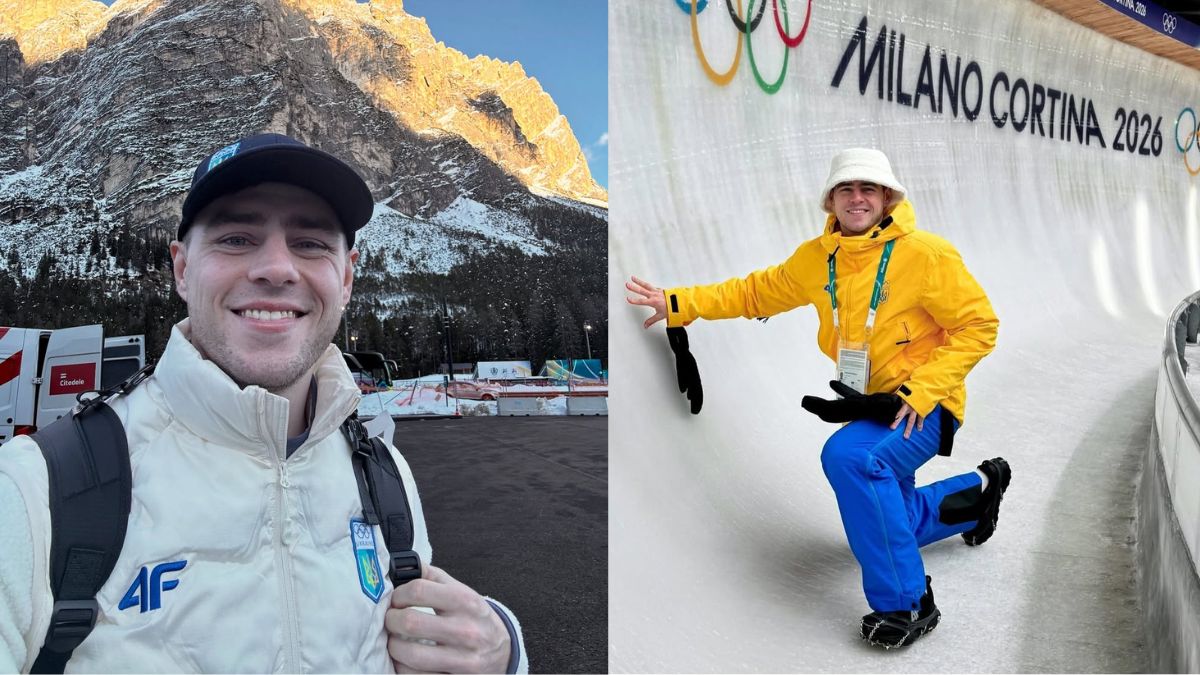
Vladyslav Heraskevych grew up watching his father Mykhailo compete in bobsledding, sliding down icy tracks at speeds most people only experience in cars. Mykhailo never reached the Olympics himself, but he saw potential in his son that went beyond what he’d achieved. When Vladyslav showed interest in winter sports, Mykhailo made a decision—he would become his son’s coach, dedicating himself to creating Ukraine’s first-ever skeleton racer.
This wasn’t just athletic ambition. This was a former Soviet athlete from a newly independent Ukraine trying to establish his country’s presence in a sport where they had zero tradition, zero infrastructure, and zero international recognition. Every training session, every competition entry, every piece of equipment represented building something from nothing.
Born January 12, 1999, in Kyiv, Vladyslav would grow up to earn a Master’s degree in physics while simultaneously becoming a world-class athlete—a combination that defines both his analytical approach to sport and his understanding that there’s more to life than racing down ice tracks headfirst at 80 miles per hour.
Basic Information
| Category | Details |
|---|---|
| Full Name | Vladyslav Mykhailovych Heraskevych |
| Date of Birth | January 12, 1999 |
| Age | 27 years old (as of 2026) |
| Birthplace | Kyiv, Ukraine |
| Nationality | Ukrainian |
| Height | Information not publicly disclosed |
| Sport | Skeleton (sled racing) |
| Position | Pilot (solo athlete) |
| Father/Coach | Mykhailo Heraskevych (former bobsledder) |
| Education | Master of Science in Physics, Taras Shevchenko National University of Kyiv (2022) |
Growing Up in Post-Soviet Kyiv
Vladyslav was born just eight years after Ukraine gained independence from the Soviet Union in 1991. His childhood happened during a period when Ukraine was rebuilding its national identity, establishing new systems, and figuring out what it meant to be Ukrainian rather than Soviet.
His father Mykhailo had competed in bobsledding during the Soviet era, giving the family unique insight into winter sports. But Ukraine’s independence meant starting over—new national teams, new funding structures, new international relationships. Sports that required expensive facilities and equipment, like bobsledding and skeleton, were especially challenging for the newly independent nation.
Details about his mother and extended family remain private. He hasn’t publicly discussed siblings, and family information beyond his father’s role as coach stays out of public view. This privacy reflects Ukrainian cultural norms where personal family matters aren’t typically shared with media.
Education: The Physicist Who Races
While many elite athletes sacrifice education for sport, Vladyslav took a different path. He attended the Ukrainian Physics and Mathematics Lyceum in Kyiv—a specialized school for academically gifted students focusing on STEM subjects.
After completing secondary education, he enrolled at Taras Shevchenko National University of Kyiv, one of Ukraine’s most prestigious universities. He studied physics at the Faculty of Physics, pursuing both undergraduate and graduate degrees while competing internationally in skeleton.
In 2022, he completed his Master of Science degree in Physics. His thesis examined “the low-temperature magnetoresistance of functionalized multiwall carbon nanotubes”—complex research involving how certain materials conduct electricity at extremely cold temperatures.
This wasn’t just academic box-checking. He published his thesis research and co-authored at least six peer-reviewed physics papers on topics including the conductivity of polymer composites with nanocarbon fillers. According to his official Olympics profile, he balanced world-class athletics with legitimate scientific research.
His physics training influenced his athletic approach. Skeleton racing involves understanding aerodynamics, friction coefficients, optimal sled positioning, and how minute adjustments affect speed. His scientific mind helped him analyze and improve performance systematically rather than relying purely on instinct.
Read Also: Ben Ogden Biography: American Cross-Country Skier’s Career and Personal Life
Finding Skeleton After Boxing
Before skeleton, Vladyslav tried boxing. The combat sport taught him mental toughness and physical conditioning, but it wasn’t his calling. When his father suggested trying skeleton—a sport where athletes race headfirst down an icy track on a small sled—he was skeptical but willing.
Skeleton requires lying face-down on a sled just inches off the ice, navigating turns at speeds exceeding 80 mph while experiencing forces up to 5Gs. Crashes can be catastrophic. The mental challenge is as significant as the physical—overcoming fear while making split-second decisions at extreme speed.
He began training in 2014 at age 15, becoming Ukraine’s first skeleton athlete. His father Mykhailo, drawing on bobsledding experience, coached him despite having no formal skeleton training himself. They learned together, studying international competitors and adapting techniques.
Building Ukraine’s Skeleton Program from Zero
Unlike countries with established skeleton traditions like Germany, Canada, and the United States, Ukraine had no tracks, no coaches, no equipment suppliers, and no funding structure. Every aspect required building from scratch.
Vladyslav trained at international facilities, often traveling to Latvia’s Sigulda track or Germany’s tracks for ice time. His early competitions meant competing against athletes from countries with decades of infrastructure investment while representing a nation just learning the sport existed.
In February 2016, at age 16, he competed at the Winter Youth Olympics in Lillehammer, Norway, finishing 8th. A month earlier, he placed 17th at the Junior World Championships in Winterberg, Germany. These weren’t medal performances, but they were historic—Ukraine’s first skeleton competitor at international championships.
The following year, he improved to 10th place at Junior Worlds in Sigulda, Latvia. Then came another milestone: on February 24, 2017, he became the first Ukrainian athlete ever to compete in skeleton at the World Championships, finishing 24th in Königssee, Germany.
World Cup Debut and Olympic Journey
On November 10, 2017, Vladyslav made his World Cup debut in Lake Placid, United States, finishing 27th. That season he competed in 7 of 8 races, ranking 24th in overall World Cup standings—respectable for a teenager from a country with no skeleton tradition.
His breakthrough came in the 2018-19 season. On January 15, 2018, Ukraine received one quota spot for men’s skeleton at the PyeongChang 2018 Winter Olympics—the first ever for Ukraine in this sport.
At the PyeongChang Olympics, he finished 12th overall. In his fourth and final run, he placed 7th—a performance celebrated in Ukraine as enormous success. The result was significant enough that Ukrainian Public TV company UA:First started broadcasting Skeleton World Cup races for the first time in Ukrainian television history.
The next season started strong—he finished 9th in Sigulda, Latvia, showing he could compete with established nations’ athletes. At the 2019 World Championships, he finished 14th, continuing his steady improvement.
Before the 2022 Beijing Olympics, he showed consistent results, twice reaching top-10 finishes and qualifying for all second runs in races he entered. On December 31, 2022, he achieved his best World Cup finish—6th place in Sigulda—proving he belonged among the world’s elite.
Net Worth & Income Sources
Exact net worth figures for Vladyslav Heraskevych are not publicly disclosed. Skeleton is governed by the IBSF (International Bobsleigh & Skeleton Federation) and does not operate on high commercial salary structures like football, basketball, or tennis.
As an elite Ukrainian skeleton athlete, Heraskevych’s income primarily comes from national federation support, Olympic committee funding, and IBSF World Cup prize money. Prize money in skeleton is relatively modest and is awarded mainly to top finishers. Athletes representing Ukraine also receive structured support that covers training, equipment, and international competition travel rather than large personal salaries. Sponsorship opportunities in skeleton are limited compared to mainstream sports, making long-term financial stability dependent on education and professional planning — an area where Heraskevych’s Master’s degree in physics provides strong career security beyond athletics.
Ethnicity and Cultural Identity
Vladyslav is ethnically Ukrainian. He was born and raised in Kyiv, speaks Ukrainian fluently, and represents Ukrainian culture and national identity through his athletic career.
His athletic journey reflects post-Soviet Ukrainian experience—rebuilding national institutions, establishing international presence, and competing without the infrastructure advantages that established Western nations possess.
Read Also: Jessie Diggins: Career, Family Background and Personal Life
About The Author