
Jordan Shipley’s football career reads like a classic Texas sports story—high school legend, college star, brief NFL stint, and a life-altering accident that tested everything he’d built. Born in Temple, Texas, and raised in small-town football culture, he broke nearly every receiving record his home state had before becoming one of the University of Texas’s most decorated wide receivers.
His legacy goes beyond statistics. He was part of one of college football’s most prolific quarterback-receiver combinations with Colt McCoy, played in a BCS National Championship game, and became a two-time All-American.
In January 2026, Jordan Shipley faced a serious personal challenge following an accident on his ranch in Texas. According to a report published by ESPN, he was hospitalized after the incident, and his family requested privacy during his recovery. Beyond the initial reports, no further verified medical details have been publicly disclosed.
Quick Profile Overview
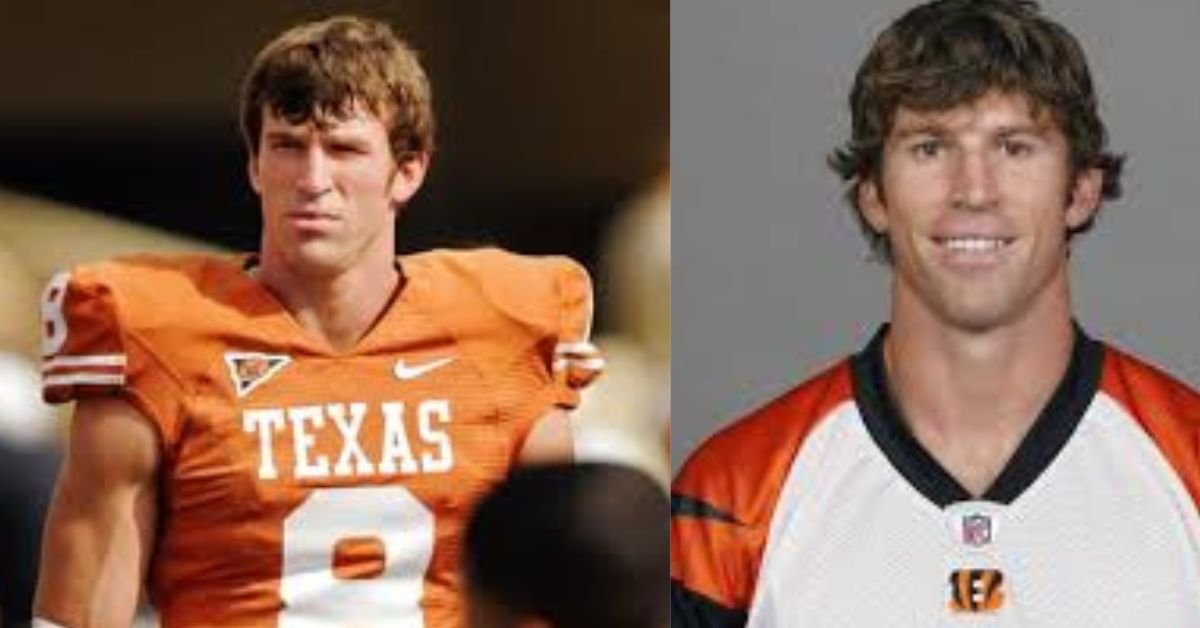
Jordan Shipley is a former American football wide receiver who achieved All-American status at the University of Texas before playing four seasons in the NFL with the Cincinnati Bengals, Tampa Bay Buccaneers, and Jacksonville Jaguars.
He was born December 23, 1985, in Temple, Texas, and became known for his exceptional speed, reliable hands, and ability to score from anywhere on the field. Beyond football, he’s worked in broadcasting, hosted outdoor television programs, and manages a ranch near his hometown of Burnet, Texas.
Early Life and Family Background
Born on December 23, 1985, in Temple, Jordan grew up in a family where football was more than entertainment—it was the family business. His father, Bob Shipley, played college football at Abilene Christian University and later became a high school football coach. His grandfather, Richard Felts, also played at Abilene Christian, establishing a multi-generational connection to the sport.
His uncle, Steven Shipley, is the second-leading receiver in TCU history, proving athletic talent ran throughout the family. These connections meant Jordan grew up understanding football from coaching, playing, and strategic perspectives that most kids never experienced.
Bob Shipley served as head coach first at Rotan High School, then Burnet High School, which meant Jordan actually played under his father’s coaching during his high school years. This dynamic created both advantages and pressures—he learned the game from someone who knew it intimately, but also faced expectations that came with being the coach’s son.
The family valued education alongside athletics. Jordan was a prep honor student who posted a 3.96 GPA, showing discipline extended beyond the football field into academics. This work ethic would later serve him well at Texas, where he earned his degree while maintaining athletic excellence.
Interestingly, Bob Shipley was college roommates with Brad McCoy—Colt McCoy’s father—at Abilene Christian. This connection meant Jordan and Colt essentially grew up in parallel football families, a relationship that would later produce one of college football’s most successful quarterback-receiver partnerships.
Education and College Football Career
Jordan attended the University of Texas at Austin, enrolling in 2004 as part of coach Mack Brown’s recruiting class. His college journey, however, started with frustration rather than glory. He redshirted his freshman year, then suffered a knee injury before the 2005 season that cost him another full year. Two years without playing threatened to derail everything before it started.
He finally got on the field in 2006, catching just 16 passes—a modest beginning for someone who arrived with massive high school credentials. The 2007 season saw slight improvement with 27 receptions, but he was still playing behind established receivers like Limas Sweed and Billy Pittman.
The breakthrough came in 2008. Building chemistry with quarterback Colt McCoy, he caught 89 passes for over 1,000 yards. His performance against Oklahoma that season became Texas football legend—he returned a kickoff 96 yards for a touchdown, the longest kickoff return in the 103-year history of the Red River Rivalry. Later that same game, he set a school record with 15 receptions against Oklahoma State.
After the 2008 season, he applied for and received medical hardship status from the NCAA, granting him an additional year of eligibility despite having already played four seasons. According to the official University of Texas Athletics Hall of Honor page at https://texaslonghorns.com/honors/hall-of-honor/jordan-shipley/930, he was a finalist for the Biletnikoff Award (nation’s top receiver) and a semifinalist for the Maxwell Award (nation’s top player) as a senior.
His 2009 senior season was spectacular. He set single-season Texas records with 116 receptions and 1,485 receiving yards, while catching 13 touchdown passes. On November 7, 2009, he caught 11 passes for a school-record 273 yards against UCF—a performance that still stands in the Texas record books.
He finished his Texas career as the all-time leader in receptions (248) and ranked second in receiving yards (3,191) and receiving touchdowns (33). Beyond receiving, he was a dangerous return specialist, scoring three touchdowns on punt returns and one on kickoff returns during his Texas career.
He graduated in December 2008 with a degree in kinesiology, then began working toward a master’s degree while playing his final season. He made the Athletics Director’s Honor Roll four times, proving academic success alongside athletic achievement.
The 2009 season culminated with Texas reaching the BCS National Championship Game against Alabama. Jordan caught two touchdown passes in that game, but Texas lost 37-21, ending his college career just short of the ultimate prize.
Professional Football Career
The Cincinnati Bengals selected Jordan in the third round (84th overall) of the 2010 NFL Draft—a solid draft position reflecting his college success. His rookie season showed promise: 52 receptions, 600 yards, and three touchdowns. His best game came against Atlanta when he hauled in six catches for 131 yards, including a 64-yard touchdown.
However, his rookie season also introduced him to the brutal reality of NFL violence. In Week 4, Cleveland Browns safety T.J. Ward delivered a helmet-to-helmet hit that caused a concussion, sidelining him the following week. Ward was fined $15,000 for the illegal contact—small consolation for Jordan dealing with concussion symptoms.
The 2011 season brought catastrophe. In Week 2 against Denver, he tore both his ACL and MCL—two critical knee ligaments destroyed in a single play. The injury ended his season immediately and began a rehabilitation process that would ultimately end his NFL career.
During the 2012 preseason, it became clear he hadn’t fully recovered. The Bengals waived him on August 17, 2012. Offensive coordinator Jay Gruden explained: “Right now, we have a lot of good players at that position, and something had to be done.” The statement was diplomatic, but the message was clear—his knee couldn’t support NFL-level performance anymore.
He briefly joined the Tampa Bay Buccaneers practice squad, then had a stint with the Jacksonville Jaguars in late 2012, appearing in a handful of games. But the magic from his Texas days never returned. His NFL career totaled just 24 games with 79 receptions for 858 yards and four touchdowns—a fraction of what his college dominance suggested was possible.
On February 18, 2014, he officially retired from professional football at age 28. The decision was realistic rather than surprising—his knee simply couldn’t withstand the physical demands anymore.
Injuries, Challenges, and Career Impact
Injuries defined his career trajectory more than almost any other factor. The knee injury that cost him the entire 2005 college season started a pattern. While he eventually recovered and thrived at Texas, that early setback cost him valuable development time and established his knees as a vulnerability.
The 2011 ACL and MCL tears represented the beginning of the end. These injuries don’t just heal with time—they require extensive surgery, months of rehabilitation, and even with perfect recovery, the joint is never quite the same. Professional football demands explosiveness, cutting ability, and confidence in your body’s capacity to handle violent collisions. Once that confidence is gone, performance suffers.
Most recently, according to ESPN‘s report at , he suffered severe burns in an accident on his ranch near Burnet on January 7, 2026, when a machine he was operating caught fire. He was driven to a local hospital by a ranch worker and then care-flighted to Austin.
This accident reminds us that life after football carries its own dangers—perhaps different from football’s violence but no less serious. As of this writing, his condition has been described as critical but stable, with his family requesting privacy while he recovers.
Physical Appearance and Athletic Profile
Jordan stood 6 feet tall and weighed approximately 190 pounds during his playing career—smaller than many NFL receivers but typical for college slot receivers. His high school measurements listed him at 170 pounds with 4.4-second 40-yard dash speed, indicating he was always built more for quickness than power.
His athleticism extended beyond football. At Texas, he ran track, posting personal bests of 10.85 seconds in the 100 meters and 21.76 seconds in the 200 meters. These times confirm legitimate track-level speed that translated to his ability to create separation from defenders and score from anywhere on the field.
His build was that of a possession receiver rather than a deep threat, though he could do both. He had reliable hands, ran precise routes, and understood how to find soft spots in zone coverage—skills that made him Colt McCoy’s favorite target during crucial third-down situations.
Personal Life and Relationships
Jordan married Nashville songwriter Sunny Helms on May 21, 2011. The couple’s relationship began years earlier—they first met in 1999 in Rotan, Texas, where he was an eighth-grade quarterback and she was a freshman cheerleader. Their story represents a classic high school sweetheart narrative that survived years of separation, college, and professional careers.
Sunny works as a songwriter in Nashville’s music industry, giving the couple connections to both football and entertainment worlds. Details about their married life remain relatively private, with both maintaining low profiles on social media and keeping family matters out of public discussion.
He was college roommates with Colt McCoy at Texas, a friendship that extended beyond football. His younger brother, Jaxon Shipley, also played wide receiver at Texas from 2012-2015, catching passes from Case McCoy (Colt’s younger brother), creating an interesting parallel between the families. Jaxon briefly played in the NFL with the Arizona Cardinals in 2016.
His cousin, Braden Shipley, is a professional baseball player who was drafted by the Arizona Diamondbacks and later played for the Kansas City Royals organization, showing athletic talent extends across multiple branches of the family.
Net Worth and Income Sources
Jordan Shipley’s net worth has not been officially disclosed. Public estimates are based primarily on his NFL playing career and limited post-football media work. According to publicly available contract data from Spotrac, his overall earnings place him in the low seven-figure range, although exact figures have not been confirmed.
NFL rookie contracts typically include signing bonuses and base salaries. As a third-round pick, his initial contract with Cincinnati likely included a signing bonus around $300,000-500,000 with base salaries escalating each year. Over four NFL seasons, his total football earnings probably reached $1.5-2 million before taxes and agent fees.
After retirement, he diversified income through media work. He co-hosted “The Bucks of Tecomate” on the Outdoor Channel, a hunting and outdoor lifestyle show that provided both income and kept him in the public eye.
In 2018, he joined the Texas GameDay crew on Longhorn Network, providing analysis and commentary for Texas Football broadcasts. This work continued into 2019, connecting him back to the university and program that made him famous.
He owns a ranch near Burnet, Texas—the same ranch where his recent accident occurred. Ranch ownership and management represents both lifestyle choice and potential income through cattle, hay, or other agricultural operations common in Central Texas.
Legacy and Life After Football
His statistical legacy at Texas remains impressive. He still holds the school record for single-game receptions (15) and single-season receptions (116). His career reception total (248) leads all-time, and only Roy Williams has more career receiving yards in Texas history.
In 2015, he was inducted into the Texas High School Football Hall of Fame, recognizing his record-setting prep career where he finished as the state’s all-class career leader in receptions (264), receiving yards (5,424), and receiving touchdowns (73).
In 2020, the University of Texas inducted him into their Hall of Honor, the highest recognition the athletic program bestows. This honor places him among the elite athletes in Texas history across all sports.
Beyond formal honors, his influence continues through his brother Jaxon’s career and his ongoing connection to Texas Football through broadcasting. He represents a link between Texas’s championship era under Mack Brown and current generations of Longhorn fans.
His ranch work and outdoor lifestyle reflect a return to his small-town Texas roots—choosing land, cattle, and rural life over urban celebrity. This choice aligns with values emphasized in Burnet and Central Texas communities where he was raised.
Frequently Asked Questions
How old is Jordan Shipley?
He was born on December 23, 1985, making him 40 years old as of January 2026. He recently suffered severe burns in a ranch accident and is recovering in an Austin hospital.
What records does he hold at Texas?
He holds Texas records for most career receptions (248), most single-season receptions (116), most single-season receiving yards (1,485), most receptions in a single game (15), and most receiving yards in a single game (273).
Why did his NFL career end?
His career ended primarily due to a devastating knee injury in 2011 where he tore both his ACL and MCL. He never fully recovered the explosiveness and confidence needed for NFL-level play, leading to his retirement in February 2014.
Is he married?
Yes, he married Sunny Helms, a Nashville songwriter, on May 21, 2011. They first met as teenagers in Rotan, Texas, when he was in eighth grade and she was a high school freshman.
Read Also: Liam Rosenior Biography: From Professional Footballer to Head Coach
About The Author
