When you hear the name Skarsgård, expectations come pre-loaded. A Swedish acting dynasty. Multiple brothers in the business. A father with more than a hundred film credits spanning decades. The assumption is that doors opened easily, that success arrived through family connections rather than individual merit.
Alexander Skarsgård’s career challenges that assumption. Yes, he was born into privilege and access that most actors never receive. But what distinguishes his path isn’t the advantages he had—it’s what he did with them, and more importantly, what he walked away from when they threatened to define him entirely.
This profile explores the contrasts that define him: fame sought and rejected, military service between acting chapters, blockbuster roles alternating with challenging independent films, and a public persona that reveals very little while seeming entirely open.
Profile Snapshot
| Category | Details |
|---|---|
| Full Name | Alexander Johan Hjalmar Skarsgård |
| Date of Birth | August 25, 1976 |
| Birthplace | Stockholm, Sweden |
| Nationality | Swedish |
| Height | 6 feet 4 inches (193 cm) |
| Profession | Actor, Producer, Writer, Director |
| Years Active | 1984–present (with breaks) |
| Known For | True Blood, Big Little Lies, The Northman |
Growing Up in a Famous Household
Alexander was born the eldest of what would eventually become six children to actor Stellan Skarsgård and physician My Skarsgård. His father was already an established actor in Sweden, though international fame wouldn’t arrive until later with films like Breaking the Waves and the Pirates of the Caribbean franchise.
Despite Stellan’s success, the family lived modestly in a working-class Stockholm neighborhood. His parents deliberately chose an environment where their children wouldn’t be isolated in entertainment industry bubbles. Alexander attended regular schools and experienced relatively normal childhood circumstances considering his father’s profession.
Four of his siblings—Gustaf, Bill, Valter, and half-brother Kolbjörn—also became actors. Two others, Sam and Eija, pursued different paths. The household was, by Alexander’s own description, “bohemian” and open, valuing creative expression without forcing career choices.
Being the eldest meant Alexander experienced his father’s rising fame first and most directly. By the time his younger brothers entered acting, Stellan had become internationally recognized, changing the context in which they navigated the industry.
Stepping Away Before Stepping In
At age seven, Alexander appeared in his first film, Åke and His World (1984), cast by a director friend of his father’s. At thirteen, he landed the lead role in the Swedish TV movie The Dog That Smiled (1989), which became a surprise hit and made him a national celebrity practically overnight.
The attention terrified him. “The fame was scary to me,” he recalled years later. “When people stare at you and you read about yourself in papers—at 13 it just got very confusing.” His confidence, he said, went “down the drain.”
So he quit. For nearly eight years, he turned down every acting offer. Instead, he focused on education, considered architecture, and at nineteen applied for mandatory Swedish military service.
He served eighteen months in the Swedish Navy’s SäkJakt unit, which handled anti-sabotage and anti-terrorism operations in the Stockholm archipelago. The experience provided structure, discipline, and crucially, distance from the acting world that had overwhelmed him as a child.
Choosing Acting on His Own Terms
After completing military service in 1996, Alexander attended Leeds Metropolitan University in England for six months, ostensibly to study English. By his own admission, he barely studied. “We lived in this basement with no heating, sleeping in sleeping bags, and shared a bathroom with a drug dealer who was obsessed with the queen of Sweden for some reason… It was kind of scary.”
But the party-focused months in Leeds served a purpose. During that time, he confronted the question he’d been avoiding: what did he actually want to do with his life? Acting came up again, and he decided to “give it a last go.”
He moved to New York City in 1997 and enrolled in theater courses at Marymount Manhattan College for six months. After returning to Stockholm, his time studying theater had confirmed what he needed to know—he genuinely wanted to act, not because of family expectation but because the work itself mattered to him.
According to his IMDb biography, his father Stellan supported the earlier decision to quit completely. “You have to love it,” Stellan told him. “If you don’t feel that way, do the other thing, whatever it is.” That permission to walk away made returning possible on Alexander’s own terms rather than continuing out of obligation.
Breakthrough Roles That Changed Perception
He rebuilt his career slowly through Swedish film, television, and theater productions. While vacationing in Los Angeles in 2001, he auditioned for and landed a small role in Zoolander as Meekus, a mindless male model. The role was tiny, but it marked his entry into American film.
His international breakthrough came in 2008 with HBO’s Generation Kill, playing Marine Sergeant Brad “Iceman” Colbert. Executive producer David Simon initially doubted whether a Swedish actor could handle the American accent convincingly. After four auditions in three cities and extensive work with a dialect coach, Alexander won the role just thirty-six hours before flying to Namibia for seven months of desert filming.
Before Generation Kill even aired, he was cast in another HBO project that would define his career for years. Initially reluctant about playing a vampire, he auditioned for True Blood after learning Alan Ball—creator of Six Feet Under, a show Alexander admired—was behind the project.
He didn’t get the role he auditioned for. Instead, he was cast as Eric Northman, a thousand-year-old Nordic vampire who first appeared in the show’s fourth episode. The character brought him international prominence and ran from 2008 to 2014.
During the True Blood years, he earned approximately $275,000 per episode according to multiple sources. The show provided both fame and financial stability, but it also typecast him in ways he would spend the next decade working to overcome.
Acting Style and Role Selection
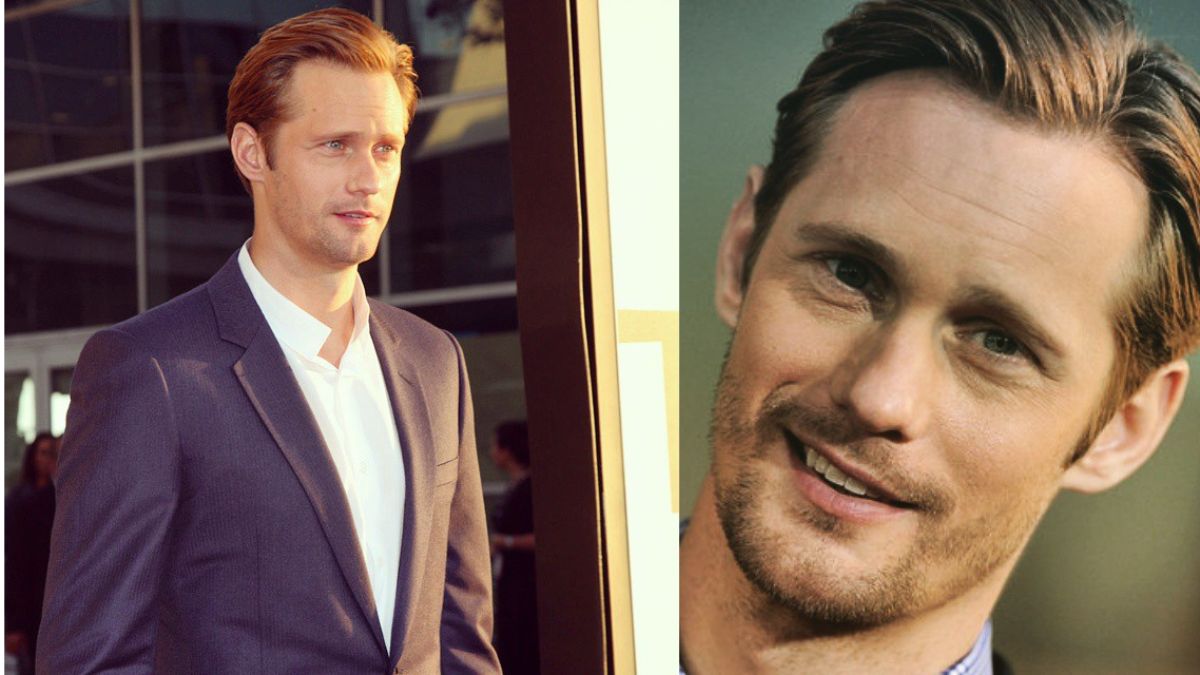
Alexander’s physical presence dominates most scenes. He has used that height both as advantage—playing warriors, vampires, Tarzan—and against type, finding vulnerability in characters whose size suggests invulnerability.
His role selection reveals deliberate choices to avoid easy paths. After True Blood ended, he could have pursued similar vampire or supernatural roles. Instead, he took the villainous husband Perry Wright in Big Little Lies (2017-2019), a performance that earned him both an Emmy and a Golden Globe.
He has worked repeatedly with director Lars von Trier, appearing in Melancholia (2011) alongside his father Stellan. He produced and starred in The Northman (2022), a brutal Viking revenge film that eschewed typical action movie conventions for mythological authenticity.
His willingness to play sexually vulnerable characters—in films like Passing (2021) and Pillion (2025)—demonstrates comfort with roles that complicate easy masculine archetypes his physicality might suggest.
Awards, Recognition, and Industry Respect
Beyond his Emmy and Golden Globe wins for Big Little Lies, Alexander received Emmy nominations for his role as tech mogul Lukas Matsson in Succession (2021-2023). His performance in that series showed range entirely different from both the vampire sheriff and the abusive husband that had defined his television work previously.
Critical reception has generally praised his ability to find humanity in characters that could easily become one-dimensional. Directors repeatedly cite his professionalism and willingness to commit fully to roles regardless of their commercial prospects.
In 2011, he received an honorary degree from Leeds Metropolitan University, the same institution where he had mostly partied a decade earlier—a gesture acknowledging both his success and his connection to the school.
Net Worth and Career Economics
According to Celebrity Net Worth, Alexander’s net worth is estimated at approximately $14 million as of 2025. This figure represents accumulated earnings from two decades of consistent work across television, film, and production.
His True Blood salary provided the financial foundation, earning him roughly $2 million per season during the show’s later years. Film roles in projects like The Legend of Tarzan (2016), Godzilla vs. Kong (2021), and The Northman added substantially, though specific salaries for these productions haven’t been publicly disclosed.
He has also earned income as a producer, particularly on The Northman, which he executive produced. Production credits create additional revenue streams through profit participation that can exceed upfront acting fees depending on a film’s performance.
It’s worth noting that some sources claim significantly higher net worth figures—one questionable report suggested $185 million, which appears inflated and inconsistent with verified industry earnings for actors at his level. The $14 million estimate aligns more closely with documented salaries and typical industry patterns.
Relationships and Personal Life
Alexander maintains strict boundaries around his personal life. He has been in a relationship with Swedish actress Tuva Novotny since around 2020, and the couple welcomed a son in 2022. They live separately—he in Sweden, she in Denmark—an arrangement that reflects their approach to balancing relationship and independence.
Previous relationships with actress Kate Bosworth and model Alexa Chung received media attention, though he rarely discussed them publicly. He has stated explicitly that he doesn’t want people to know too much about him personally, believing it’s “easier for people to suspend belief that way.”
His father Stellan has said similar things about protecting family privacy, a value Alexander clearly inherited and maintains despite considerable media interest in his personal life.
Physical Presence and Public Image
His height—6 feet 4 inches—makes him one of the taller leading men in Hollywood. Combined with an athletic build maintained through regular fitness training, his physical presence shapes how he’s cast and perceived.
On red carpets and in fashion contexts, he carries himself with understated elegance rather than flashy presentation. He has been voted “Sexiest Man in Sweden” five times, though he seems neither particularly interested in nor bothered by such designations.
Media portrayal often emphasizes his looks over his craft, a tendency he has worked against through role selection that demands more than physical presence. His performance in Big Little Lies particularly challenged audiences to see past his appearance to recognize actual acting skill.
Life Outside Acting
He supports Hammarby Fotboll, a Stockholm-based football club, and has participated in fundraising events for the team. In 2013, he served as Ambassador for the American team in Walking with the Wounded, a charity supporting injured soldiers. He trekked to the South Pole alongside Prince Harry (UK team ambassador) and Dominic West (Canada/Australia team) in a competitive fundraiser that ultimately became collaborative when hazardous conditions required the teams to combine forces.
He has stated publicly that he is an atheist and a feminist, two positions he has discussed in interviews without making them central to his public identity. He speaks Swedish, English, and French fluently.
Since 2023, he has lived primarily in Stockholm after two decades based in New York and Los Angeles. The return to Sweden reflects both personal preference and professional flexibility—his career no longer requires constant proximity to Hollywood.
Challenges, Risks, and Reinvention
The decision to quit acting at thirteen could have ended his career permanently. Child actors who step away rarely return successfully. That he did—and on his own terms—demonstrates unusual self-awareness and patience.
Taking the Big Little Lies role risked alienating fans who knew him primarily as the charismatic vampire Eric Northman. Playing an abusive husband required audiences to see him as genuinely threatening rather than attractively dangerous, a shift many actors in his position would avoid.
Producing The Northman involved significant financial and creative risk. The film underperformed commercially despite critical acclaim, but it demonstrated his commitment to ambitious projects over safe commercial choices.
Read Also: Liam Neeson: Acting Career, Family Life and Personal Journey
About The Author