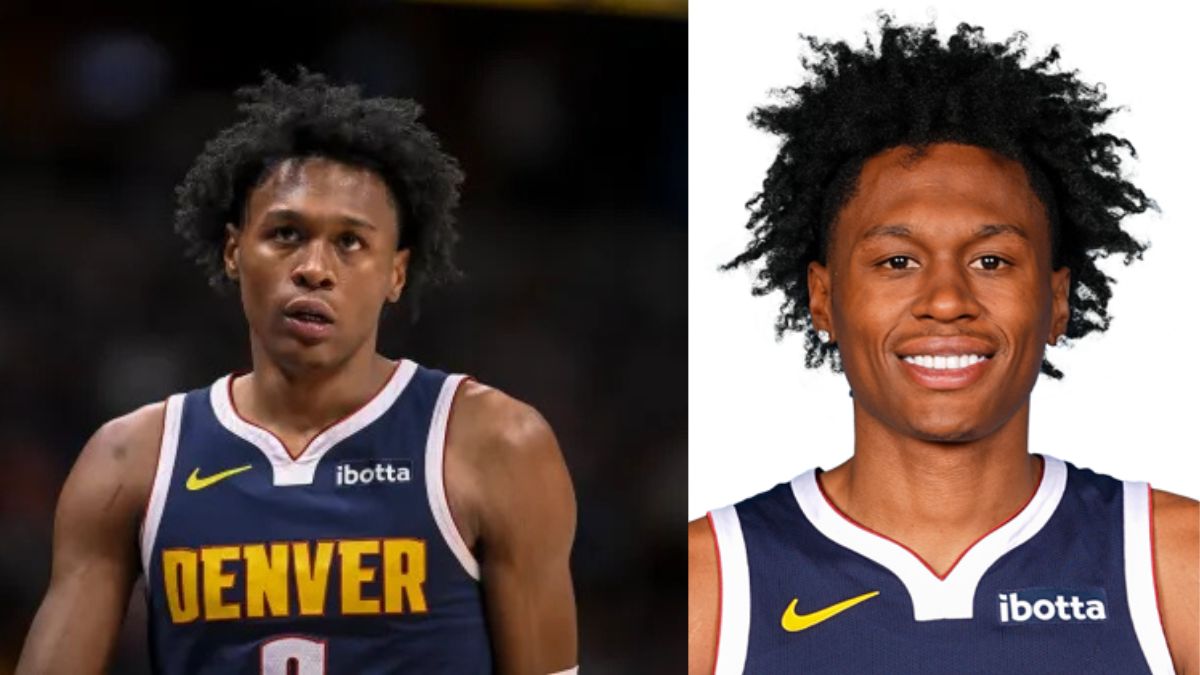
Peyton Watson has emerged as one of the NBA’s most exciting young talents, transforming from a developmental prospect into a genuine two-way threat for the Denver Nuggets. His journey from Long Beach, California to NBA champion represents dedication, family support, and continuous improvement.
At just 23 years old, he has already won an NBA championship and established himself as a defensive specialist with rapidly developing offensive skills. His breakout performances during the 2025-26 season have captured the attention of basketball fans and analysts across the league.
The combination of elite athleticism, defensive versatility, and improving offensive game makes him one of the most intriguing young players in professional basketball today.
Quick Profile
| Detail | Information |
|---|---|
| Full Name | Peyton Tyler Watson |
| Date of Birth | September 11, 2002 |
| Age | 23 years old |
| Birthplace | Beverly Hills, California |
| Height | 6’8″ (203 cm) |
| Position | Small Forward / Shooting Guard |
| NBA Team | Denver Nuggets |
| Jersey Number | 8 |
| Draft | 2022, 1st Round (30th overall) |
| College | UCLA |
Early Life in Southern California
Peyton Tyler Watson was born on September 11, 2002, in Beverly Hills, California, but grew up in nearby Long Beach. The vibrant Southern California basketball culture shaped his early development as a player.
Long Beach has produced numerous professional athletes over the years, creating an environment where young talent is nurtured and competitive basketball is taken seriously from an early age.
His introduction to basketball came remarkably early. According to reports, he started playing basketball around age two, influenced heavily by his father who recognized his son’s natural athleticism and coordination.
As a toddler around age three, he fell in love with the sport by attending his uncle Brantley Watson’s high school games at Dominguez High School, where he was captivated by the players’ pregame warm-up routines.
Even at that young age, he began mimicking defensive slides and movements at home, laying the groundwork for his future emphasis on perimeter defense as a versatile wing. This early fascination with defense would become a defining characteristic of his game.
Parents and Family Background
Peyton Watson comes from a supportive and athletic-minded family that played a crucial role in his basketball development. He is the firstborn of his parents, Julio Watson and Antoinette Watson.
His father, Julio Watson, works as a medical device representative, according to sources like sportskeeda. More importantly for Peyton’s basketball journey, Julio coached Peyton at the Eastman Club in Long Beach, California, where the young Watson first picked up a basketball and began developing basic skills.
Julio’s background as a former basketball player and coach gave him unique insight into developing his son’s talent. He understood not just the physical aspects of the game but also the mental preparation required for success at higher levels.
His mother, Antoinette Watson, works as an event planner. While she may not have had direct basketball experience, her organizational skills and support proved equally valuable to Peyton’s development.
According to his official NBA bio, Peyton is the oldest of Julio and Antoinette’s three children and has one younger brother, Christian, and one younger sister, Jolie Grace.
His younger brother Christian also plays basketball, having attended Long Beach Polytechnic High School where Peyton starred. His uncle, Brantley Watson, graduated from UCLA, the same university Peyton would later attend.
The Watson family has African-American heritage and strong roots in Southern California’s athletic community. Their support system proved essential as Peyton navigated the demanding path from youth basketball to professional sports.
Youth Basketball Development
Peyton Watson’s basketball education began in the structured environment his father created. His father had played a vital role in his rise as an NBA Champion by coaching him at the Eastman Club and got him started with basketball at an early age.
The Eastman Club in Long Beach provided a local competitive environment where young Watson could develop fundamental skills while playing against other talented youth players in Southern California.
His parents’ involvement extended beyond just coaching. They regularly took him to basketball games, exposing him to high-level competition and allowing him to study how better players moved, defended, and competed.
This early emphasis on watching and learning created habits that would serve him throughout his career. Understanding basketball IQ and defensive positioning from such a young age gave him advantages that purely physical gifts alone could not provide.
During his youth basketball years, he participated in local circuits and AAU programs that exposed him to top competition across California and beyond. While specific tournament achievements from this period aren’t extensively documented, the consistent competitive exposure built his game.
His physical development during these years was steady but not extraordinary. He grew gradually toward his eventual 6’8″ frame without experiencing a single massive growth spurt that disrupted his coordination or skill development.
High School Career at Long Beach Poly
Peyton Watson attended Long Beach Polytechnic High School, one of California’s most prestigious athletic programs. Long Beach Poly has produced numerous professional athletes across multiple sports, creating high expectations for its basketball players.
He joined the varsity basketball team as a freshman, which is relatively uncommon and demonstrates the talent he showed early. His freshman year was spent mostly coming off the bench, learning the speed and physicality of high school varsity competition.
As a sophomore, he continued developing while still primarily serving in a reserve role. The coaching staff, led by Shelton Diggs, recognized his enormous potential even when he wasn’t starting.
Coach Shelton Diggs said of Watson early in his career: “He’s gonna be the best player in the city the next two years and he has a chance to be one of the all-time Poly greats. You know I don’t say that lightly.”
His junior season marked his breakout. He assumed a leading role on the team and averaged 23.2 points and eight rebounds per game, earning Moore League MVP honors.
His senior year cemented his status as one of the nation’s elite prospects. He led Long Beach Poly to an impressive 15-1 record and a spot in the CIF Southern Section Division 1 championship game.
By the end of his high school career, he was named to the rosters for the McDonald’s All-American, Jordan Brand Classic and Nike Hoop Summit. These are the most prestigious high school all-star games, reserved for the absolute elite prospects.
Watson became a consensus five-star recruit, one of the top small forwards and the highest-ranked player from California in the 2021 recruiting class.
Recruiting Process and UCLA Commitment
As a five-star prospect, Peyton Watson attracted attention from elite college programs across the country. Major programs recognized his defensive versatility, length, and athletic upside as exactly the type of player who could excel at the next level.
He received scholarship offers from numerous top programs including Arizona, Gonzaga, Michigan, Oregon, Washington, USC, Arkansas, Texas Tech, and Missouri, among others. The competition for his commitment was intense.
An invitation to a USA Basketball youth camp proved pivotal. According to reporting, Watson arrived as a mid-major recruit with not much scholarship attention and left the camp as a top 15 player in his class, with college coaches across the country banging down his door.
He took official visits to several schools, carefully evaluating each program’s fit for his development and future NBA aspirations. On July 27, 2020, he announced his commitment to UCLA during a live broadcast.
Several factors influenced his decision to choose the Bruins. UCLA’s proximity to his Long Beach home allowed his family to attend games easily and remain part of his support system. Playing for head coach Mick Cronin, known for his defensive focus and player development, appealed to Watson’s strengths.
He was frank with the Bruins coaching staff that he intended to be a one-and-done player, leaving for the NBA after one year in college. This honest communication set appropriate expectations for both sides.
College Career at UCLA
Peyton Watson arrived at UCLA in 2021 with high expectations as a five-star recruit. However, his freshman season did not unfold as he had hoped.
As a freshman at the University of California, Los Angeles in 2021–22, Watson arrived out of shape, primarily due to his high school senior season being disrupted by the COVID-19 pandemic.
The pandemic had disrupted normal training and preparation, leaving him less physically ready for the demands of Pac-12 basketball than he would have been under normal circumstances.
He also joined an experienced UCLA group that had advanced to the Final Four of the NCAA tournament a year earlier with all five starters returning. This meant opportunities for playing time were limited, with veteran players holding most rotation spots.
Watson’s defense was more advanced than his offense, but the Bruins had other established scorers. His role became primarily defensive, entering games to provide energy and perimeter defense rather than offensive production.
His statistics reflected his limited role. He averaged 3.3 points and 2.9 rebounds in 12.6 minutes per game, and made just 32.2% of his field goals and 22.6% of his three-pointers.
Playing time was sporadic, and he struggled to find consistent rhythm. His shooting percentages suffered from limited opportunities and the adjustment to college basketball’s speed and physicality.
Despite the challenging season, he received honorable mention for the Pac-12 All-Freshman Team, recognizing his defensive contributions and potential even in limited minutes.
After the season, he declared for the 2022 NBA Draft, forgoing his remaining college eligibility. The decision reflected his assessment that he could better develop his game at the professional level.
2022 NBA Draft and Trade to Denver
The 2022 NBA Draft represented the culmination of Peyton Watson’s amateur basketball journey. Despite his limited offensive production at UCLA, NBA teams recognized his defensive potential, athleticism, and physical tools.
Watson was selected by the Oklahoma City Thunder in the first round of the 2022 NBA draft with the 30th overall pick. Being taken in the first round guaranteed him a four-year contract and validated his decision to leave UCLA early.
However, his time with Oklahoma City lasted only minutes. He was then traded to the Denver Nuggets along with two future second-round picks for JaMychal Green and a 2027 protected first-round draft pick.
The draft night trade sent him to Denver, a team coming off a playoff run and looking to build depth behind their star core of Nikola Jokić and Jamal Murray.
When he was drafted, Watson stood and blinked a few times in the bright spotlight before hugging his mother Antoinette, his father Julio, his sister JoJo, his uncle Brantley, his brother Christian, and close family friend Damian Massey.
Denver Nuggets General Manager Calvin Booth explained the team’s thinking in selecting Watson. Booth said: “Peyton Watson is a great kid with unbelievable potential. Very intelligent, loves basketball, loves playing defense. He guarded all positions, he’s blocking shots. Offensively it didn’t go well for him last year to be honest, but I believe he has offensive ability. He loves to play defense though, he’s a basketball junkie, and he’s really intelligent. He has all-NBA defense potential.”
The Nuggets saw Watson as a long-term developmental project who could eventually contribute to championship contention with his elite defensive tools.
Rookie Season: NBA Champion
Peyton Watson’s rookie season (2022-23) was spent primarily developing his game. Possessing a wide wingspan, Watson was projected as a long-term project and expected to spend time developing with the Grand Rapids Gold of the NBA G League.
He shuttled between the NBA roster and the G League affiliate, which is standard for young players who need playing time to develop but aren’t yet ready for consistent NBA minutes.
His NBA playing time during the regular season was limited. He appeared in just 26 games, averaging 2.6 points and 1.8 rebounds in 8.5 minutes per game. The limited action reflected both his developmental status and Denver’s depth as a contending team.
However, being part of a championship team provided invaluable learning experiences. He practiced daily against NBA-caliber players, learned from veteran teammates, and absorbed the professional approach required for success.
The pinnacle of his rookie year came in June 2023 when Watson ended his rookie season as an NBA champion when the Nuggets defeated the Miami Heat in the NBA Finals.
While he didn’t play significant minutes in the playoffs, earning a championship ring in his first professional season gave him a foundation of success and championship culture that many players never experience.
Sophomore and Third Seasons: Building a Role
Watson’s second season (2023-24) marked significant progress in his development. He appeared in 80 games, showing the Nuggets’ increased confidence in his ability to contribute.
According to his player profile, he averaged 6.7 points, 3.2 rebounds, 1.1 assists, and 1.1 blocks per game in 18.6 minutes. While modest, these numbers represented substantial improvement from his rookie campaign.
His defensive impact became increasingly apparent. He blocked 88 shots total, tying for 14th in the NBA despite playing far fewer minutes than other players on that list. His shot-blocking ability as a wing player made him uniquely valuable.
He recorded a career-high six blocks in a game against Minnesota on April 10, 2024, becoming the first Nuggets bench player with six or more blocks in a game since JaVale McGee in 2012.
His defensive versatility allowed him to guard multiple positions, from quick guards on the perimeter to larger forwards in the post. This flexibility made him increasingly valuable in Denver’s defensive schemes.
The 2024-25 season saw continued gradual improvement, but nothing prepared observers for what would come in the 2025-26 season.
2025-26 Breakout Season
The 2025-26 season has been transformational for Peyton Watson. When injuries sidelined key Nuggets players including Nikola Jokić, Christian Braun, Cameron Johnson, and Aaron Gordon, Watson stepped into expanded opportunities.
According to current statistics from NBA, he is averaging 14.8 points, 4.9 rebounds, and 2.1 assists per game this season while shooting 49% from the field.
His scoring has increased dramatically, and his offensive confidence has grown alongside his minutes. The combination of necessity and opportunity allowed him to showcase skills that had been developing behind the scenes.
In November 2025, Watson set new career-highs with 32 points and 12 rebounds in a 125-118 win over the New Orleans Pelicans.
His performances during early 2026 reached another level. Watson won his first NBA Western Conference Player of the Week Award for his play during the week of January 5-11, 2026, averaging 24.5 points, 8 rebounds, 4 assists, 1.3 steals, and 1.8 blocks.
On January 22, 2026, Watson notched a new career-high in points, pouring in 35 points to help Denver defeat the Washington Wizards, 107–97.
His defensive excellence has continued alongside his offensive breakout. He remains one of the league’s most versatile defenders, capable of guarding positions one through four effectively.
High-profile players have taken notice of his emergence. Golden State Warriors forward Draymond Green recently praised Watson extensively on his podcast.
Green said: “Peyton Watson has gotten so much better. Don’t be surprised at the emergence of Peyton Watson… He clearly has a high-level processor. When you have a high-level processor in this league, it’s an advantage.”
Green went even further, predicting: “So y’all keep an eye out for Peyton Watson. That kid is going to be an All-Star, no questions asked.”
Playing Style and Strengths
Peyton Watson’s game is built on elite defensive versatility combined with growing offensive capabilities. His physical tools make him uniquely effective on both ends of the floor.
At 6’8″ with a long wingspan, he has ideal size for an NBA wing. His 200-pound frame provides strength without sacrificing mobility, allowing him to stay in front of quicker guards while also holding position against bigger forwards.
Defensively, his instincts and processing speed stand out. He reads passing lanes exceptionally well, anticipates offensive actions, and positions himself to make plays on the ball.
His shot-blocking ability is rare for a wing player. He times his contests perfectly and uses his length to alter or block shots without fouling. His weak-side shot-blocking particularly disrupts opponents’ offensive flow.
The versatility to guard multiple positions makes him invaluable in modern NBA schemes. He can switch seamlessly in pick-and-roll coverage, contest shots at the rim, and close out on three-point shooters.
Offensively, his game has developed significantly from his UCLA days. His three-point shooting has improved to over 40% this season, making him a legitimate floor-spacing threat.
He attacks closeouts aggressively, using his length and athleticism to finish at the rim. His handle has improved enough to create some advantages in one-on-one situations, though this remains an area for continued development.
His basketball IQ, praised by opponents like Draymond Green, allows him to make correct reads in transition and cut effectively in half-court offense. He doesn’t force bad shots and understands his role within Denver’s offensive system.
Read Also: Javonte Green Biography: Height, Parents, Wife, Education & NBA Career
Physical Attributes and Conditioning
According to official measurements, Peyton Watson stands 6’8″ (203 cm) tall and weighs 200 pounds (91 kg). These measurements place him squarely in the ideal range for an NBA wing player.
His wingspan, while not officially published in all sources, is notably long and contributes significantly to his defensive effectiveness and shot-blocking ability.
Maintaining his conditioning has been crucial to his success. Early in his career, arriving at UCLA out of shape taught him the importance of year-round physical preparation.
He has worked diligently with NBA strength and conditioning staff to build the endurance required for extended minutes at the professional level. His ability to play 30+ minutes per game during his breakout reflects this improved conditioning.
The challenge for wing players his size is maintaining strength for physical play while preserving the agility needed to defend quicker guards. Watson has struck this balance effectively through dedicated training.
Contract and Financial Situation
Peyton Watson signed his rookie contract with the Denver Nuggets after the 2022 draft. According to salary information from spotrac, Watson signed a 4 year, $11,267,516 contract with the Denver Nuggets, including $11,267,516 guaranteed.
For the 2025-26 season, Watson will earn a base salary of $4,356,476. This represents the final year of his rookie-scale contract.
Crucially, Watson is currently in the final year of his four-year, $11.2 million rookie contract and did not sign a contract extension before the deadline in October 2025, which means he will become a Restricted Free Agent (RFA) in the summer of 2026.
As a restricted free agent, the Nuggets will have the right to match any offer sheet he signs with another team. This gives Denver significant leverage but doesn’t guarantee they’ll retain him, particularly given their salary cap situation.
His breakout season has complicated Denver’s financial planning significantly. According to analysis from cbs sports, the Nuggets already have approximately $185.7 million committed to five players for the 2026-27 season before even addressing Watson’s contract.
Multiple teams with cap space, including the Lakers, Jazz, Nets, and Wizards, could offer Watson significant contracts that Denver would struggle to match given salary cap restrictions.
Net Worth and Earnings
Peyton Watson’s net worth is estimated to be between $4 million and $5 million as of 2026, according to reporting from Surprise Sports. These figures are estimates based on his NBA earnings and potential endorsement deals.
His career earnings through the 2024-25 season total over $6.9 million from NBA salary alone. With his final rookie year paying $4.36 million, his career earnings through this contract will exceed $11 million.
His next contract, set to be negotiated in the summer of 2026, could be substantially larger. Depending on market dynamics and Denver’s willingness to pay, he could sign a deal worth anywhere from $60 million to over $100 million across multiple years.
Beyond NBA salary, he likely earns additional income from endorsement deals, though specific details about sponsorships are not extensively publicized. As his profile grows, endorsement opportunities should increase.
He has represented himself professionally through agents James Dunleavy and Sam Goldfeder of Excel Sports Management, who will negotiate his next contract.
For perspective, comparable players who broke out in their third or fourth seasons have signed contracts ranging from $15-25 million annually. Watson’s unique defensive value combined with improved offense could place him in or above this range.
Personal Life and Relationships
Regarding his personal life, Peyton Watson has maintained relative privacy while focusing on his basketball career. According to recent reporting, Peyton Watson is engaged to Hannah Holmes, with the couple having planned their wedding for April 25, 2026, which is scheduled to take place in Texas.
Hannah Holmes has been supportive throughout his early NBA career and is often seen attending Nuggets games. Their relationship appears strong as they prepare for marriage during what will be a pivotal year professionally with his pending free agency.
Beyond his relationship, Watson keeps most personal details private. He doesn’t frequently share information about his lifestyle, hobbies, or interests outside basketball on social media or in interviews.
His social media presence, primarily on Instagram where he has over 120,000 followers, focuses mainly on basketball content including game highlights, workout videos, and team-related posts.
He maintains close relationships with his family, particularly his parents who were instrumental in his development. His younger brother Christian’s basketball career also keeps the family connected to the sport they all love.
Read Also: Luka Dončić Height: Biography, NBA Career, Parents, Partner & Relationship
About The Author