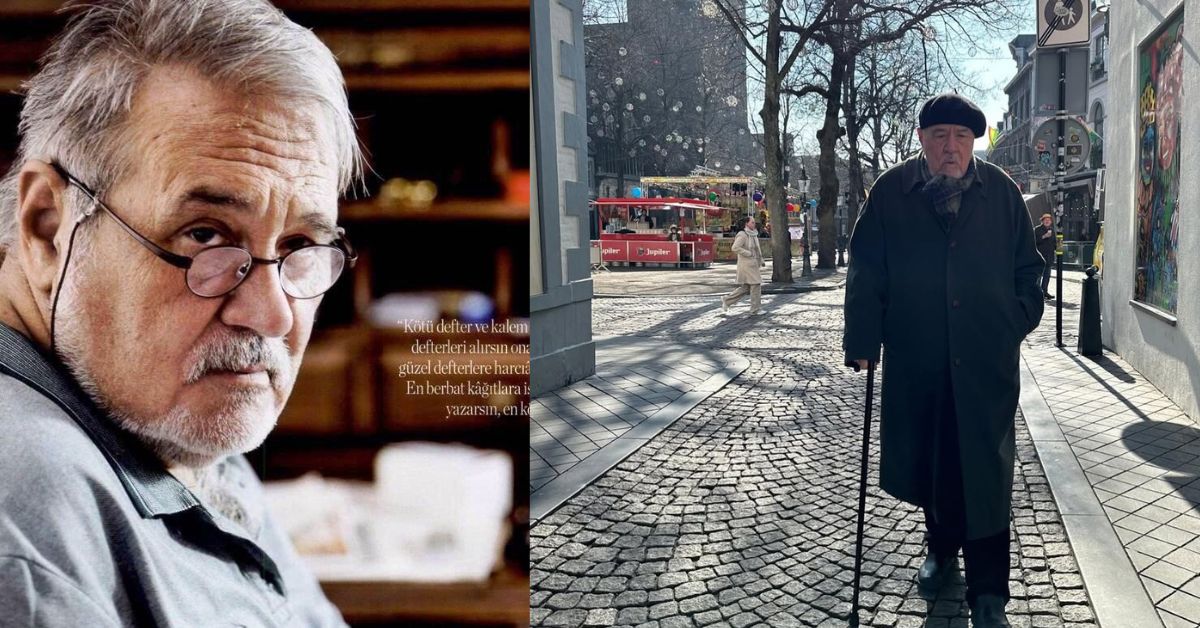
İlber Ortaylı didn’t just teach Ottoman history—he made millions of Turks fall in love with it. The man who could switch between nine languages mid-sentence, who directed the Topkapı Palace Museum, and who became a television icon transformed how an entire nation understood its past.
Born on May 21, 1947, in a refugee camp in Bregenz, Austria, Ortaylı came from a Crimean Tatar family that fled Stalin’s persecution. The family moved to Istanbul when he was 2 years old. From those refugee camp beginnings, he became Turkey’s most recognizable historian—a man whose sharp tongue and encyclopedic knowledge made him both beloved and feared.
His life story is one of intellectual courage, linguistic mastery, and the power of making scholarship accessible without dumbing it down.
Crimean Tatar Roots and Family Background
İlber Ortaylı was born into a Crimean Tatar family in a refugee camp in Bregenz, Austria. His family was from the village of Ortay in Kefe (Feodosia), Crimea, fleeing Stalin’s persecution and killings. The surname “Ortaylı” literally means “from Ortay,” marking his ancestral village.
His parents were a well-educated couple. His father Kemal was an engineer who spoke Turkish, Russian, English and German, while his mother Şefika taught Russian at Ankara University’s Faculty of Language, History and Geography. Şefika descended from a noble Crimean family whose ancestors counseled the khans of the Crimean Khanate and produced some of Crimea’s muftis.
Thanks to his multilingual family environment, Ortaylı grew up speaking Turkish, German, and Russian from childhood. He also had three siblings: Enver, Emeldar, and Nuriye.
This multilingual, intellectually rich household shaped everything that followed. History was not abstract—it was his family’s lived experience of displacement, survival, and cultural preservation.
Ethnicity, Religion and Cultural Identity
İlber Ortaylı was ethnically Crimean Tatar, a Turkic people indigenous to the Crimean Peninsula. The Crimean Tatars are a distinct ethnic group with their own language (Crimean Tatar), culture, and history dating back centuries.
His family’s Muslim heritage was evident—his mother’s ancestors served as religious scholars and muftis in Crimea. However, Ortaylı himself maintained a secular, scholarly approach to history rather than a religiously oriented one.
His identity as a Crimean Tatar refugee shaped his perspective on empires, borders, and the human cost of political upheaval. He never forgot that his family’s displacement was part of Stalin’s broader campaign of ethnic cleansing against the Crimean Tatars.
As a polyglot historian he was proficient in Turkish, Italian, English, French, Arabic, Persian, Ottoman Turkish, Russian and Latin. This linguistic mastery allowed him to read primary sources in their original languages—a skill he constantly emphasized as essential for real historical scholarship.
Education: From Istanbul to Vienna to Chicago
Ortaylı studied at Saint Georg Austrian High School in Istanbul and then Ankara Atatürk High School before earning his history degree from Ankara University in 1970. At Ankara University’s Faculty of Language, History and Geography, he studied under giants: Şerif Mardin, Halil İnalcık, Mümtaz Soysal, Seha Meray, İlhan Tekeli, and Mübeccel Kıray.
He earned postgraduate degrees at the University of Chicago under Professor Halil İnalcık and at the University of Vienna, where he studied Slav and Eastern European languages. His master’s work at Chicago and doctoral studies at Vienna gave him perspectives beyond Turkish nationalism.
He completed his doctoral thesis on Ottoman local administration in 1978 and became an associate professor a year later at Ankara University’s School of Political Sciences.
His education spanned three continents and multiple academic traditions, giving him a comparative framework that few Turkish historians possessed.
The Historian Who Quit in Protest
In 1981, his book on German influence on the late Ottoman Empire was published, establishing his scholarly credentials. But then came a moral choice that defined his character.
In 1982, he resigned from his position, protesting the academic policy of the government after the military coup of September 12, 1980. Rather than compromise his principles under military rule, he left Turkey entirely.
For the next seven years, he taught at universities worldwide: Vienna, Berlin, Paris, Princeton, Moscow, Rome, Munich, Strasbourg, Cambridge, Oxford, and Tunis. These years broadened his perspectives and built international networks that would serve him throughout his career.
In 1989, he returned to Ankara University and became professor of history, serving as head of the Department of Administrative History from 1989 to 2002.
His willingness to sacrifice his career for principle earned him respect that mere scholarship never could.
Marriage, Divorce and Personal Life
Ortaylı married Ayşe Özdolay at age 35 and had a daughter, Tuna. The couple divorced in 1999 and Ortaylı never remarried. Ayşe Özdolay was the daughter of Dr. Talip Özdolay, a former senator from Mersin.
Their daughter Tuna Ortaylı Kazıcı was born on March 27, 1982. The marriage lasted 18 years before ending in divorce in 1999. After the divorce, Ortaylı remained single for the rest of his life, dedicating himself entirely to scholarship and public education.
He rarely discussed his personal life publicly, preferring to keep family matters private while being extraordinarily public about intellectual matters. This separation between private life and public persona was consistent throughout his career.
Read Also: Adrian Autry Biography: Career, Family & Net Worth
Director of Topkapı Palace Museum
Thanks to his special knowledge and attention to detail, Ortaylı was appointed as director of the Topkapı Palace Museum for seven years before he retired from the position in 2012. This appointment from 2005 to 2012 gave him direct access to Ottoman archives and artifacts.
His tenure modernized the museum’s operations while maintaining scholarly rigor. He emphasized making the collection accessible to researchers while protecting its integrity. Visitors during his directorship often encountered the director himself, walking the halls and explaining Ottoman history to anyone who would listen.
The position also gave him a public platform that extended beyond academia. As director of Turkey’s most iconic museum, he became the face of Ottoman historical preservation.
The Man Who Made History Popular
Beginning with popular discussion panels in the 1980s, Ortaylı carried historiographical debates about Turkey and the Ottomans to the public. Leveraging his vast knowledge and effective public speaking skills, Ortaylı gained a positive reputation in the media and among the public.
He began publishing columns, essays and articles in collected volumes in the early 2000s, which became best-selling books in the country, bringing great fame to the sophisticated historian.
His television appearances were legendary. Professor Doctor İlber Ortaylı became one of the most favorite figures at discussion programs thanks to his mental agility and distinctive humoristic personality. He was sharp, impatient with ignorance, and unafraid to publicly correct people—including prominent politicians and celebrities.
Social media turned him into memes. His snobbish dismissals of “semi-ignorance” became viral quotes. Though a serious historian and official museum director, Ortaylı was transformed into a “Nasreddin Hodja” type figure—the wise man whose cutting remarks contained deeper truths.
Major Works and Publications
Ortaylı authored over 40 books, including İmparatorluğun En Uzun Yüzyılı (The Empire’s Longest Century) (1983), Osmanlı’yı Yeniden Keşfetmek series, Tarihin İzinde (2008), and Bir Ömür Nasıl Yaşanır? (2019).
Other significant works include:
- Türkiye İdare Tarihine Giriş (Introduction to Turkish Administrative History) (1996)
- Osmanlı Aile Yapısı (Family Structure in the Ottoman Empire) (2000)
- Osmanlı İmparatorluğu’nda İktisadi ve Sosyal Değişim (Economic and Social Change in the Ottoman Empire) (2001)
His published articles were mainly in Turkish, German and French, with many translated into English. He wrote on diplomacy, cultural history, intellectual history, Russian history, urban history, and provincial administration.
His books became bestsellers—a rare achievement for academic historians. He proved that rigorous scholarship and popular accessibility were not mutually exclusive.
International Recognition and Awards
In 2001, he received the Aydın Doğan Foundation Award in the field of history for his works, articles, books, efforts to popularize history, and international role in Turkish historiography.
In 2007, he received the Medal of Pushkin for his “great contribution to the spread and study of the Russian language, preservation of cultural heritage and rapprochement of different cultures” under a decree signed by Vladimir Putin.
In 2011, he was chosen as honorary member of the Macedonian Academy of Sciences and Arts. He was also a member of the Foundation for International Studies, the Societas Iranologica Europeae, and both the Austrian and Turkish Academies of Sciences.
His recognition extended far beyond Turkey, reflecting his truly international scholarly reputation and his ability to bridge Eastern and Western academic traditions.
Net Worth and Financial Matters
As an academic and public intellectual in Turkey, Ortaylı earned income from multiple sources: university salaries, book royalties, television appearances, and speaking engagements. His books became bestsellers, generating substantial royalties over decades.
However, specific net worth figures for Turkish academics are rarely disclosed publicly. His lifestyle appeared comfortable but not ostentatious—focused on books, travel for research, and intellectual pursuits rather than material accumulation.
Unlike many public intellectuals who monetize their fame extensively, Ortaylı remained primarily committed to scholarship and education rather than wealth accumulation.
Read Also: Ravi Bellamkonda Biography: Life Journey, Family, Career & Ohio State University Presidency
About The Author